The previous series of three posts attempted to bridge Asset Based Community Development (ABCD) with Systems Thinking, the two sections of the New Community Paradigms (NCP) wiki seen as being among the furthermost separated. Bridging NCP wiki-sections is a basic feature of the wiki, especially with the NCP wiki-map but the differences in conceptual approaches between the two are especially distant. Both were discovered in this search for new community paradigms. There is a bias towards Systems Thinking, not due to longer exposure, 2015, 2016 in earnest for ABCD and 2013 for Systems Thinking but to a natural affinity. Still learning both. The bridging of the two was done across a presumption of complexity incorporating both. Complexity, to be clear from the start, is seen as actually a good thing and necessary though all too often incoherent if not problematic.
The recent blog post, Ostrom, the Commons, and the Green New Deal continued to explore the development of concepts involving dynamic complex systems previously raised in this blog. In addition to bridging concepts, there is a desire to establish a deeper and firmer foundation through biological constructs such as Carrying Capacity and an interest shown in Ostrom's work by anthropologists.
This post questions how far ABCD relational practices and Ostrom’s polycentric governance can be extended limited by the increasing complexity inherent in larger groups or wider circles of Dunbar's Number. The reach of ABCD, and more indirectly Ostrom's polycentric governance, is arguably restricted by Dunbar's Number.
There are four layers, or "Circles of Acquaintanceship," or implicit social contracts making up Dunbar’s number scaling relatively consistently to each other. The first circle is three to five of our very closest friends. The next layer or circle is twelve (the size of a jury) to fifteen persons whose death would devastate us. Next circle is made up of fifty persons, or “the typical overnight camp size among traditional hunter-gatherers like the Australian Aboriginals or the San Bushmen of southern Africa.”
Beyond the fourth level of one hundred and fifty persons, there are still further circles with an ideal democracy set at five thousand, three hundred. Larger circles though involve even greater degrees of complexity and far less emotional attachment, especially between non-familial relationships.
Though usually in agreement or sympathy, there are a few points with which I don't see the same as Cormac Russell, Managing Director of Nurture Development and faculty member of the ABCD Institute, leaning towards Dunbar’s empiricism but then I am a keeps-himself-to-himself in-his-own-head type introvert so biased in my perspective.
Cormac does not include family members (or professionals), only true associates, in his associational connections and Dunbar does with kin prioritized. He sees Dunbar’s fourth level at 150 persons as a minimum meaning most of us have a deficit of 99 persons, not including familial relationships, to make up for from our average base of 51 persons in our associational lives. He knows that Dunbar saw the fourth level of 150 as a maximum limit which I suspect few people truly reach. It is not just walking distance separating people but emotional distance as well. As the number of people in a circle increases the emotional connection between them decreases with each successive circle and there are physiologically set cognitive limits.
However, it is Cormac’s vision of community associational relationships that must be strived towards to create the needed systemic changes in the direct democracy governance of our communities which requires not only connections but diversity as well to deal with complex even wicked problems. ABCD then becomes a necessary and even a primary component of New Community Paradigms but not necessarily a sufficient one.
The question to be considered then is how Ostrom’s polycentric governance of community and the commons could help ABCD extend the network of implicit contracts and, as importantly, how ABCD could support Ostrom’s polycentric governance to develop the required trust essential to achieve the advantage of those implicit social contracts.
As has been asserted before, Asset Based Community Development seeks to help communities find solutions to community challenges upon the basis of a system of community-based associational relationships to develop community wealth or resources as opposed to economic wealth or money by a few.
Most larger geographically placed, politically defined by institutional government type communities such as cities or towns are usually composed of many diverse socially and often demographically defined place-based communities or neighborhoods of differing levels of influence.
There are other distinct types of community in addition to these that can extend beyond geographic boundaries but still not be necessarily separate. Communities, in the context of this post and ABCD, will refer to neighborhoods and smaller social-based communities. Larger entities such as cities are dealt with through their institutions.
The previous series went over questions that ABCD believes each community or anyone sincerely wishing to build better communities needs to ask. An issue for many communities then is whether they or anybody are even asking these essential questions? ABCD seeks to change this by committing to re-seeding associational life at a hyper-local level (i.e. street level). ABCD is about the strengthening of social capital or what could also be considered the Carrying Capacity within a community to save people from a life of institutionalization by creating community alternatives to the institutional (systems) world.
ABCD and Community, a Systemic Analysis pt 3 reminded us that the carrying capacity of a local community depends upon good stewardship of that community’s welfare ideally requiring the correct sequencing of nurturing at three levels. The first level is recognizing that there are things that communities do best on their own without institutional assistance. The second level is recognizing that there are things that communities can basically do themselves but with some help from outside agencies. The third level is recognizing that there are things that communities need to have done for them by outside agencies. Something institutions readily and often exclusively do.
At the third level, the system being generated likely becomes entrenched, leading to a form of top-down service delivery by command, being persistent and resilient even while failing to address the needs of its supposed beneficiaries while eroding social capital and creating high levels of dependence on external resources which are now disappearing.
Neighborhoods have experienced years of interacting with the different public and private institutional agencies which have provided services of one kind or another, under the auspices of governmentally defined agencies, but not at equal levels. Outside agencies, institutional or otherwise, ideally should seek to be in the right relationship with smaller social, demographic, cultural communities. However, it has been many of these very same agencies who have failed, are still failing, and are now looking for means to systematize their failure as a new normal.
Cormac sees this institutionalization causing further atomization or breaking up of relationships or people’s sense of community into individual elements in what I believe can be interpreted as being a system of disorganized complexity. This is not considered an oxymoron, even disorganized gas molecules can be made to react (behave) in certain ways through proper manipulation. ABCD though could also involve the atomization of a community but to the level of independent agents connecting potentially in a self-organizing fashion through a system of organized complexity as defined by Jane Jacobs, structured by Ostrom and systematized by Meadows.
Without proper investment in community building through the correct Agency interactions or better community conversations, institutional stewardship remains stuck at the third level while second level interactions can be commodified drifting towards the third level in the name of efficiencies and there is little incentive to make any extended investment. The first level carrying capacity then is relegated to fighting to retain whatever influence on to which the community may be holding on let alone endeavoring to increase its social capital.
What leverage then is afforded to local communities or even those working sincerely and earnestly in support of local communities to ensure that this is done properly? Even if attempted, providing the proportionate support that does not displace or diminish local community power is a difficult balancing act with the best of intentions. It isn't by the communities themselves, at least not initially, and it is doubtful that it is the institutional agencies so is there presumably a third sector or movement outside of these communities that are being appealed to beyond the already converted to the ABCD approach?
This post will also reveal the connection of ABCD back to the concept of the Commons and Ostrom’s work, a path already established in the blog post-ABCD, Social Networks and the Commons connecting Associational Life:
“A viable way to be collective and inclusive from the bottom up, according to Cormac and those with a similar mindset, is to work through the concept of the communal Commons to enable some type of Coalition of the Doing in determining the relationship between Capitalism and the Commons".
David Bollier, Director of the Reinventing the Commons Program at the Schumacher Center for a New Economics, starts off the article speaking of enclosures as the historical anthesis to the Commons.
“Enclosures eclipse the history and memory of the commons, rendering them invisible. The impersonal, individualistic, transaction-based ethic of the market economy becomes the new normal.”
An enclosure, as defined by Bollier, then can be seen as a form of imposed exclusion, a means of differentiating between clique or exclusive communities and colony or excluded communities.
A Commons, within an ABCD framework, can then be seen as both place-based with the resources of that place and people-based as an associational network overseeing those resource-based commons. The Social Network is both a people-based defined social system overseeing the Commons as a place-based resource so that the smallest associational successes of ABCD can not only reverberate through the entire community (system) but also give it history or legacy. It becomes a matter then, as Cormac has said, of not reforming (institutional) systems but reclaiming the Commons.
Showing posts with label entrenched city hall. Show all posts
Showing posts with label entrenched city hall. Show all posts
Saturday, May 4, 2019
Saturday, January 13, 2018
NCP Fantasy Systems Thinking "A" Team - Ackoff and Argyris
The next two team members on the NCP five-member Fantasy Systems Thinking Team again consists of one the same as the SP UK course and one new as with the previous post. The difference is that this time the course choice is featured more extensively in the course material discussed on these pages.
Jay Forrester and Systems Dynamics added to the team in the last post, provided what was seen as a clear, straightforward, and relatively uncluttered perspective on the basic internal mechanism comprising a system without a need for any additional lens or any particular overlaid specialized procedures. No doubt there are limitations and levels of complexity increase rapidly but it is inherent complexity not imposed layers.
Russel L. Ackoff's career provides us with insightful, overall perspectives on our approach to systems. It was Ackoff who admonished us to Never improve a part of the system unless it also improves the whole. It was Ackoff, cited in the SP UK course, who had us consider, Why Few Organizations Adopt Systems Thinking, and who, as discussed in Approaching a Systems Practice, Yet Again, contrasted “messes” with difficulties.
Managers are not confronted with problems that are independent of each other, but with dynamic situations that consist of complex systems of changing problems that interact with each other. I call such situations messes. Problems are abstractions extracted from messes by analysis; they are to messes as atoms are to tables and charts …
Managers do not solve problems, they manage messes.
He also discussed messes in the paper, Systems, Messes and Interactive Planning - Modern Times Workplace, which dealt with the evolution of systems at a paradigm level, as well as extolling the benefits of Participative Planning as something done not for or to an organization but by it, and listing the four attitudes towards planning, Inactive, Reactive, Pre-active and Interactive. There is also the four principles of planning practice that Inter-activists have extracted from their experience - participative, coordinated, integrated and continuous.
More Thinking on Mastering Systems Practice, Dealing with Messes contrasted the SP UK course’s concept of Ackoff’s idea of messes with, for this blog, the more familiar concept of wicked problems, questioning how are "messes" qualitatively different from"wicked problems”?
In Toward a System of Systems Concepts, Ackoff spoke of concrete systems meaning a system that contains at least two elements which are objects. A so-called concrete result then is a supposed state within a moment of time of a concrete system. Jay Forrester and Systems Dynamics seem especially attuned to these types of systems.
Many systems though, such as explored in Digging Systematically Deeper into Designing for a Public Participation Process are mostly abstract, meaning that they are composed of concepts which are defined in large part by the relationships between them and preset assumptions, axioms or postulates. Forrester and Systems Dynamics could still provide valuable insight but more has to be considered.
Such systems also have agents involved in them. They are a purposeful system, which Ackoff defined as one that can, “…produce the outcome in different ways in the same (internal or external) state and can produce different outcomes in the same and different states". More importantly, it can be also an Ideal-seeking system (Kumu) requiring consideration of differences between goals, objectives, and ideals and some concepts related to them. They are also invariably non-linear.
In Creating the Corporate Future 1981, pp. 26–33, Ackoff, as featured in Systems of Complexity, Complexity of Systems Part 1, asserted that for a set of elements to be usefully viewed as a system, it was necessary that the behavior of each element of the set should have an effect on the behavior of the whole set and that their effects on the whole set should be interdependent. Each subgroup, regardless of how they are formed, should have the same effect on the behavior of the whole and none should be completely independent. It was the phrase “usefully viewed as a system” or purposeful that is pertinent here in my view. The solely mechanical aspects of a car (running the engine) do not necessarily require all subsystems of the automobile to work in unison towards a purpose but as a (personal) transportation system, it could be argued that they are so required.
The outsider is Chris Argyris whose ideas on Ladder of Inference, as well as his theories of action, single and double-loop learning and organizational learning in, "Teaching Smart People How To Learn” were cited in Systems of Complexity, Complexity of Systems Part 2 and previously by New Community Paradigms in addressing meta-issues discussed in Dancing through the Complexities of Thinking Systematically about Systems Thinking.
Argyris has been more predominantly featured in the exploration and experimentation done first through Insight Maker models and then in Kumu maps. New Organizational Learning Inhibited through Bureaucratic Over Complicatedness & Corruption (IM-16192) is an Insight Maker model with three reinforcing, repeating single loops which, as defined by Argyris, twist the entire system into knots, entrenching the system into the larger environment. The storytelling format (use the “Step Forward” button at the bottom right corner) moves through the model to assert that institutions within entrenched systems can result in the “Corruption of the System” through a “Status Quo Politically Based Corruption of Entrenched Institutions” (R3).
This model was later revised in the Kumu map Inhibited Community Learning Entrenched Institutions which explored How Institutional Entities Created to Benefit Public Organizations Becomes Entrenched to Benefit Only Themselves.
Defending the institutional system’s continued existence in its current form which means maintaining the system in its current form and status of power does not necessarily mean benefiting those individuals in or coming to power. New players may be brought in but the system will be maintained regardless of any well-meaning but ineffectual attempts to change it. A system exists beyond the individuals which are a part of it, the momentum of ongoing processes, the legacy of historical structure and the conscious and unconscious mental models can thoroughly entrench a system, particularly an institutional one.
There is also the ability of institutions such as public sector institutions like city halls to impose legally sanctioned constraints that benefit the few rather than the system as a whole. This is corruption of the system going beyond the usual idea of corruption as an illegal or unethical act by someone. Corruption of a system here is seen as anything that prevents a system from fulfilling its espoused and intended purpose. Well-meaning regulations that result in unintended and unfailingly detrimental consequences are therefore also corruptions of a system.
More recently, the post Active Digital Citizens Seeking New Community Paradigms pt. 3 saw “volunteering” through civil society as important to a community because the political institutions and market institutions cannot be expected to be able or to be trusted to fulfill all the needs of the community, especially in addressing Wicked Problems. Our community challenges are increasingly complex. Our responses to these challenges, therefore, cannot be merely simplistic but needs to be coherently complex.
The blog post Virtual Systemic Inquiry - GPS for New Community Paradigms? asserted that:
“Wicked problems have become so complex, incoherently complex, that they're broken down and perceived as complicated by not only the general public but also those tasked with addressing them with top-down complicated and reductionistic based management systems, sometimes tending to reach high levels of bureaucratic complicatedness."
There is still, however, the added value question regarding any additional complexity system thinking and systems mapping might have to a complex situation or system. It is not up to the system thinker to come up with the expert answer but to first facilitate the true community question and then have them provide the answer.
The Kumu mapping project Changing Assumptions was based on Argyris’ Ladder of Inference and involved both exploration and (thought) experimentation resulting in a presentation which while it still gets increasingly complex and remains hypothetical, hopefully, could be made to provide some helpful insights. It does not provide an out of the box, one size fits all answer, each community must find its own answer.
A systems thinking approach has the potential to take a significantly different path than one dictated by a command and control management approach. The systems thinking approach can call upon the stakeholders of the system in question to take an investigation resulting from a preceding exploration and craft a strategy which will use points of leverage to address the current situation in a manner that is beneficial to the whole system by changing stakeholder and organizational behaviors and avoiding unintended consequences to the greatest extent possible.
The perception is that systemic interventions will promote successful interventions and those successful interventions will result in a better world as well as promote the perceived utility of Systems Thinking.” (Ackoff?)
Jay Forrester and Systems Dynamics added to the team in the last post, provided what was seen as a clear, straightforward, and relatively uncluttered perspective on the basic internal mechanism comprising a system without a need for any additional lens or any particular overlaid specialized procedures. No doubt there are limitations and levels of complexity increase rapidly but it is inherent complexity not imposed layers.
Russel L. Ackoff's career provides us with insightful, overall perspectives on our approach to systems. It was Ackoff who admonished us to Never improve a part of the system unless it also improves the whole. It was Ackoff, cited in the SP UK course, who had us consider, Why Few Organizations Adopt Systems Thinking, and who, as discussed in Approaching a Systems Practice, Yet Again, contrasted “messes” with difficulties.
Managers are not confronted with problems that are independent of each other, but with dynamic situations that consist of complex systems of changing problems that interact with each other. I call such situations messes. Problems are abstractions extracted from messes by analysis; they are to messes as atoms are to tables and charts …
Managers do not solve problems, they manage messes.
Future of Operational Research is Past
More Thinking on Mastering Systems Practice, Dealing with Messes contrasted the SP UK course’s concept of Ackoff’s idea of messes with, for this blog, the more familiar concept of wicked problems, questioning how are "messes" qualitatively different from"wicked problems”?
In Toward a System of Systems Concepts, Ackoff spoke of concrete systems meaning a system that contains at least two elements which are objects. A so-called concrete result then is a supposed state within a moment of time of a concrete system. Jay Forrester and Systems Dynamics seem especially attuned to these types of systems.
Many systems though, such as explored in Digging Systematically Deeper into Designing for a Public Participation Process are mostly abstract, meaning that they are composed of concepts which are defined in large part by the relationships between them and preset assumptions, axioms or postulates. Forrester and Systems Dynamics could still provide valuable insight but more has to be considered.
Such systems also have agents involved in them. They are a purposeful system, which Ackoff defined as one that can, “…produce the outcome in different ways in the same (internal or external) state and can produce different outcomes in the same and different states". More importantly, it can be also an Ideal-seeking system (Kumu) requiring consideration of differences between goals, objectives, and ideals and some concepts related to them. They are also invariably non-linear.
In Creating the Corporate Future 1981, pp. 26–33, Ackoff, as featured in Systems of Complexity, Complexity of Systems Part 1, asserted that for a set of elements to be usefully viewed as a system, it was necessary that the behavior of each element of the set should have an effect on the behavior of the whole set and that their effects on the whole set should be interdependent. Each subgroup, regardless of how they are formed, should have the same effect on the behavior of the whole and none should be completely independent. It was the phrase “usefully viewed as a system” or purposeful that is pertinent here in my view. The solely mechanical aspects of a car (running the engine) do not necessarily require all subsystems of the automobile to work in unison towards a purpose but as a (personal) transportation system, it could be argued that they are so required.
The outsider is Chris Argyris whose ideas on Ladder of Inference, as well as his theories of action, single and double-loop learning and organizational learning in, "Teaching Smart People How To Learn” were cited in Systems of Complexity, Complexity of Systems Part 2 and previously by New Community Paradigms in addressing meta-issues discussed in Dancing through the Complexities of Thinking Systematically about Systems Thinking.
Argyris has been more predominantly featured in the exploration and experimentation done first through Insight Maker models and then in Kumu maps. New Organizational Learning Inhibited through Bureaucratic Over Complicatedness & Corruption (IM-16192) is an Insight Maker model with three reinforcing, repeating single loops which, as defined by Argyris, twist the entire system into knots, entrenching the system into the larger environment. The storytelling format (use the “Step Forward” button at the bottom right corner) moves through the model to assert that institutions within entrenched systems can result in the “Corruption of the System” through a “Status Quo Politically Based Corruption of Entrenched Institutions” (R3).
This model was later revised in the Kumu map Inhibited Community Learning Entrenched Institutions which explored How Institutional Entities Created to Benefit Public Organizations Becomes Entrenched to Benefit Only Themselves.
Defending the institutional system’s continued existence in its current form which means maintaining the system in its current form and status of power does not necessarily mean benefiting those individuals in or coming to power. New players may be brought in but the system will be maintained regardless of any well-meaning but ineffectual attempts to change it. A system exists beyond the individuals which are a part of it, the momentum of ongoing processes, the legacy of historical structure and the conscious and unconscious mental models can thoroughly entrench a system, particularly an institutional one.
There is also the ability of institutions such as public sector institutions like city halls to impose legally sanctioned constraints that benefit the few rather than the system as a whole. This is corruption of the system going beyond the usual idea of corruption as an illegal or unethical act by someone. Corruption of a system here is seen as anything that prevents a system from fulfilling its espoused and intended purpose. Well-meaning regulations that result in unintended and unfailingly detrimental consequences are therefore also corruptions of a system.
More recently, the post Active Digital Citizens Seeking New Community Paradigms pt. 3 saw “volunteering” through civil society as important to a community because the political institutions and market institutions cannot be expected to be able or to be trusted to fulfill all the needs of the community, especially in addressing Wicked Problems. Our community challenges are increasingly complex. Our responses to these challenges, therefore, cannot be merely simplistic but needs to be coherently complex.
The blog post Virtual Systemic Inquiry - GPS for New Community Paradigms? asserted that:
“Wicked problems have become so complex, incoherently complex, that they're broken down and perceived as complicated by not only the general public but also those tasked with addressing them with top-down complicated and reductionistic based management systems, sometimes tending to reach high levels of bureaucratic complicatedness."
There is still, however, the added value question regarding any additional complexity system thinking and systems mapping might have to a complex situation or system. It is not up to the system thinker to come up with the expert answer but to first facilitate the true community question and then have them provide the answer.
The Kumu mapping project Changing Assumptions was based on Argyris’ Ladder of Inference and involved both exploration and (thought) experimentation resulting in a presentation which while it still gets increasingly complex and remains hypothetical, hopefully, could be made to provide some helpful insights. It does not provide an out of the box, one size fits all answer, each community must find its own answer.
A systems thinking approach has the potential to take a significantly different path than one dictated by a command and control management approach. The systems thinking approach can call upon the stakeholders of the system in question to take an investigation resulting from a preceding exploration and craft a strategy which will use points of leverage to address the current situation in a manner that is beneficial to the whole system by changing stakeholder and organizational behaviors and avoiding unintended consequences to the greatest extent possible.
The perception is that systemic interventions will promote successful interventions and those successful interventions will result in a better world as well as promote the perceived utility of Systems Thinking.” (Ackoff?)
Tuesday, June 23, 2015
Systems of Public Participation - Ideal Design versus Entrenched Reality
The previous post introduced the Designing Public Participation Processes Map which includes all twelve design guidelines cited in the Designing Public Participation Processes article, by John M. Bryson, Kathryn S. Quick, Carissa Schively Slotterback and Barbara C. Crosby, reconfigured into four groups of system's aspects, all of which are interrelated. So far, nine of the twelve design elements have been addressed in the last three posts under Systemic Design of Public Participation.
The last post raised again the complex, inherent tension within a democratic system between an ideal approach to a system of deliberative democracy, having its own constraints and challenges to being effective, against a system designed to produce desired goods and necessary functions in a manner as efficient as possible, both being integral to the overall system but functioning on two different planes. The Designing Public Participation Processes Map could perhaps be seen as a compass or navigating system for trekking through that democratic system.
The remaining three design guidelines are seen as somewhat different being closer to the interface of design with community knowing and doing. The systems portion of the map itself was titled, “Formal System of Public Participation Design”. The article’s quote that, “design choices are not made in a linear fashion” by Tina Nabatchi can be extended to, “but rather ‘through an iterative and integrative process’ applies to the design of both the internal workings and the overall, evolving public participation system.
Interface Aspects
10. Ensuring that a public participation process is needed for the specific circumstances, fits the context generally and specifically, and is based on a clear understanding of the challenge.
11. Ensuring that stakeholder analysis informs the design and implementation of public participation processes and involves, at a minimum, key stakeholders in appropriate ways across all the steps or phases. Recognizing that specific stakeholders may be involved in different ways at different steps or phases of the process.
12. Clarifying and regularly revisiting the purposes and desired outcomes of the participation process and design and redesign it accordingly.
Potential connections between various aspects of the design for public participation system have been illustrated. This particular set of design guidelines making up the Interface Aspects of the system also illustrates some internal connections, inclusiveness, co-production, purpose articulation.
The article credits government administrators, officials, and community leaders for having long recognized the value of public participation for a variety of purposes, processes, and decisions. Not so well understood, it seems, is how to design participation processes so as to achieve desirable outcomes, including what those desirable outcomes are and who decides on them. The article turns to what they term design science as the means of accomplishing this.
Conversely, the article asserts that there is currently limited recognition, among public administrators, of design science as a viable means of promoting adaptation and change, likely due to a risk-adverse culture and structural barriers.
The explanation the article makes is that design science purports to involve a shift from typical social science, involving hypothesis to establish general patterns of causality, to a problem-solving approach adapting research-based evidence to context-specific, contingent, and emergent circumstances through a science framework for developing and testing conjectures. Design science principles are situation and context specific, meaning that they are somewhat general by necessity, requiring thoughtful adaptation to specific situations, and readapting in response to emerging conditions. This requires being less averse to ambiguity and allowing for the chance of failure though by design this should be during early prototyping phases.
Considering then the purpose(s) to be served by a design is important. Determining the full final defining purpose of the process at the start may not always be possible or even desirable. One, because the context may change because the act of articulating purpose is not a one-time exercise. Two, coproducing that purpose in collaboration with participants, through the public process may be desirable. The literature on collaboration tells us that it is important to include the full range of stakeholders when the seeking of consensus is the prime decision-making method and a durable solution is sought. These are two independent considerations though and achieving one does not guarantee achieving the other. Still, according to sources of extensive research cited in the article, the chances of a decision-making “blunder” increases dramatically on strategic decisions without first consulting with key stakeholders prior to finalizing purposes and desired outcomes.
Deciding who the appropriate stakeholders should be and what the corresponding approaches to engagement should be can be, according to the article, less clear with more general and less controversial participation processes. A basic strategy for engagement for informing, for collaborating, or for empowering should be based on a clear purpose of participation. Communicating with and involving stakeholders should use different approaches throughout the process even under a new community paradigm model.
Most basic technical or operational issues facing communities don’t require substantial changes in the applicable knowledge or technology base, stakeholder relationships, broad organizational strategies, or governance mechanisms. Reality requires making and living with choices in a world with limited resources and possibilities and not every community-based undertaking requires full community participation. It is when problems are more complex and politically divisive as they are with Wicked Problems that changes in the pertinent knowledge or technology base, new concepts, and different stakeholders and different stakeholder networks need to be included.
A common perspective though, raised during LinkedIn discussions, is that the 'public engagement' process is used by government institutions or organizations looking for a rubber stamp of approval of predetermined outcomes and are generally not truly open to meaningful discussion of alternatives or the opening up of new possibilities. Institutional planners are often uncomfortable when new ideas, not their own, are put forward. How can we then design public participation in policy making that is open to new ideas bubbling up? First, let's look at what arguably occurs more frequently today.
The Design map serves as a template for possible public participation processes but as actually manifested through different relationships with different social entities in the community environment could take on numerous forms. The Public Participation Designed for Entrenched Incumbents map includes all of the same design guidelines as the Designing Public Participation Processes Map but organized very differently through causal connections. The last post stated that causal connections or loops were not developed for the Design map. The term entrenched, as used in ‘entrenched city hall’ by this blog was also reviewed recently.
A question raised through discussions on LinkedIn was whether the Designing Public Participation Processes Map included institutions or organizations? It does not, except as how they might endeavor to fulfill a role or function within the process. The Entrenched Incumbents map does, though these roles or functions could change under different configurations.
Also different is that the Entrenched Incumbents map involves the design guidelines or elements organized into processes or pathways for the active accomplishment of some objective rather than as system’s aspects serving as a template. Though seemingly an obviously overall beneficial goal, it is not necessary for all processes to serve the same overall purpose.
The Incumbent Control Pathway provides a pathway for approval of projects and policies desired by the incumbents through control over these design elements and over the public participation project management team, in whatever form it may take. There are still other elements of the design elements intended to advance participation but the public participation project management only has to put in a weak or diminished effort creating perhaps not barriers but an Incumbent Restrictions Pathway difficult to pass through. This leaves an Advocacy Intervention Pathway which has positive elements, including Inclusive Processes, but will not prevail unless community resolve overcomes the systemic influence of Participation Goals and Purpose set by the incumbents. All three pathways together do not include the connection between Community and Government which is shown as delayed as the main form of intervention, elections, take place usually only every four years. Next post will take us back to the Amplify the Voices of Community Members map.
Saturday, June 13, 2015
Digging Systematically Deeper into Designing for a Public Participation Process
So far, in digging deeper into a systemic approach to a Collective Impact effort, we have focused on a process to Amplify the Voices of Community Members through the concepts for Designing for a Public Participation Process system. We have looked, narratively, at both the overall aspects and the internal aspects of such a system.
This inclination to dig deeper into some of the material making up the Living Cities Collective Impact online course has led to the creation of a new map, using a different design to illustrate Designing Public Participation Processes, consisting of four different aspects of the system, suggested by the Designing for a Public Participation Processes article, with each including three of the article's twelve design guide elements.
The Overall Aspect or perspective is how the Designing for a Public Participation Process system works in achieving its stated goal or purposes. Mousing over the “Overall Aspects” text in the narrative box of the map will highlight that section of the map. Underneath it is the three design guidelines seen as being part of this specific aspect. These particular guidelines are seen as being closely related to each other. This is a different functional perspective from the “Internal Aspects” of the system. These and the other two aspects are all part of the same total system and it would make little to no sense to isolate any of them.
These are not the physical components of the system, like the engine of a car, but different perspectives of the functions of the system. A car has a subsystem which provides the necessary power for movement. It could be gasoline, electric or Hydrogen powered but to be mobile, the car needs a means of propulsion to be incorporated into its design.
The maps used so far have been composites consisting of elements, containing various resources, related or connected together. Each element, whether a blog post, journal article, video, organization, or other resource is connected to others based on a graphic organizing of the Living Cities Collective Impact course, with a few other resources added in.
The Designing for a Public Participation Processes map defines relationships differently. It reflects a single, integral system, taking different perspectives on various, separate functions of that system. There is more of a functional relationship between elements, either through belonging to common system aspects or active, mutual connections. What has not been developed are causal connections or loops as used in previous efforts.
There are no connections displayed from inside the system to outside the system. The nature of the outside boundary is defined both by the system and by the environment or community in which it exists. The boundary of the system is permeable but the exact manner of connections across it is not specified. Some individual elements can belong or relate to both within the system and outside of it. All elements or aspects of the system are directly or indirectly related to each other. Some, but not all of these have been identified and displayed.
Conflicts or breakdowns in connections are as important. Conflicts do not exist within the system, these would be better designated breakdowns. Conflicts, originating outside the system though could be manifested as intended breakdowns within the system. Conflicts, such as those cited by the article about the authenticity and legitimacy of the participation processes, which would cross the boundary of the system, could stem from different expectations rather than purposely attempting to manipulate the participation process.
In the past, this blog has railed against the notion of concrete results. Russell L. Ackoff in Toward a System of Systems Concepts spoke though of concrete systems. There is, however, no disagreement between the two. A so-called concrete result is a supposed state within a moment of time of a concrete system, meaning a system that contains at least two elements which are objects. The Design for Public Participation system is mostly an abstract system, meaning it is made up of concepts which are defined in large part by the relationship between them and preset assumptions, axioms or postulates.
There are also agents involved in the system. It is a purposeful system, which Ackoff defined as one that can, “…produce the outcome in different ways in the same (internal or external) state and can produce different outcomes in the same and different states". More importantly, it is also an Ideal-seeking system requiring consideration of differences between goals, objectives, and ideals and some concepts related to them. This puts it more in line with the Deliberative Systems map than with the Institutional Democratic Theory map cited in Creating Democracy is Complex, which means there is an inherent tension. How it could be integrated into the Deliberative Systems map and where it could be placed in the Integrative Deliberative Systems map would depend upon the final manifested design.
How this might play out, in reality, can be demonstrated through another systems thinking modeling tool, an InsightMaker model titled, New Community Paradigms Entrenched City Halls. The Design for Public Participation system could be seen as navigating between the Overt Reality and Underlying Reality of that process.
There also needs to be an aspect which provides foundational, infrastructure or support for the various elements, going beyond each separate aspect.
Foundational Aspects
7. Creating an appropriate set of rules to guide the overall work to be done, operational decision making, and a project management team structure to facilitate if needed. This, as the article asserts, involves recognition of rules, the substance of rules, and structures for enforcing rules.
Who gets to be involved in decision making and in what ways, regarding operational rules, general policies about the work to be done, and constitutional rules regarding who gets to make what kinds of decisions are based on influences prior to and outside the system. The rules, as part of the system, could help provide a pathway to the system's goals of allowing a process for participants, all participants not only a few, to build commitment among themselves, make or contribute to important decisions and self-monitoring.
8. Securing adequate resources and designing and managing participation processes to generate additional resources to produce a generally favorable benefit-cost ratio for the participation process.
Implementing a public participation designed to be inclusive of different self-interests and motivations to address problems, could generate unexpected resources, such as knowledge, commitment to follow-through, and enthusiasm, for decision making and policy implementation. Participants may provide new information and new ways of understanding issues generating better projects and policies, securing buy-in for decisions, limiting delays, mistakes, and lawsuits and enhancing government–community trust, social capital, and infrastructure for ongoing community action. These are difficult metrics to quantify and control though.
9. Establishing the legitimacy of the participation process, for both internal and external stakeholders, as an effective form of engagement and a source of trusted interaction among participants. The form that participation takes must be seen as:
For each strategy, regarding different levels of permitted participation, there are different kinds of engagement ranging from ignoring, engaging as a data source, informing, consulting, involving, collaborating, and finally to empowering stakeholders to make all decisions themselves. This also implies the use of different kinds of tools and techniques.
Logistically, a project management team, as mentioned above, could also be required for important, broader scale, and more time-consuming processes. This has been made a distinct element of the map. It could include sponsors, champions, and facilitators, as well as others. It would also lead to a need for adequate support staff and other resources to function effectively, depending on the scope and scale of the process, challenging a favorable benefit-cost ratio outcome. There will also be another aspect providing more of the actual interface with the community. Both will be examined more closely in the next post.
This inclination to dig deeper into some of the material making up the Living Cities Collective Impact online course has led to the creation of a new map, using a different design to illustrate Designing Public Participation Processes, consisting of four different aspects of the system, suggested by the Designing for a Public Participation Processes article, with each including three of the article's twelve design guide elements.
The Overall Aspect or perspective is how the Designing for a Public Participation Process system works in achieving its stated goal or purposes. Mousing over the “Overall Aspects” text in the narrative box of the map will highlight that section of the map. Underneath it is the three design guidelines seen as being part of this specific aspect. These particular guidelines are seen as being closely related to each other. This is a different functional perspective from the “Internal Aspects” of the system. These and the other two aspects are all part of the same total system and it would make little to no sense to isolate any of them.
These are not the physical components of the system, like the engine of a car, but different perspectives of the functions of the system. A car has a subsystem which provides the necessary power for movement. It could be gasoline, electric or Hydrogen powered but to be mobile, the car needs a means of propulsion to be incorporated into its design.
The maps used so far have been composites consisting of elements, containing various resources, related or connected together. Each element, whether a blog post, journal article, video, organization, or other resource is connected to others based on a graphic organizing of the Living Cities Collective Impact course, with a few other resources added in.
The Designing for a Public Participation Processes map defines relationships differently. It reflects a single, integral system, taking different perspectives on various, separate functions of that system. There is more of a functional relationship between elements, either through belonging to common system aspects or active, mutual connections. What has not been developed are causal connections or loops as used in previous efforts.
There are no connections displayed from inside the system to outside the system. The nature of the outside boundary is defined both by the system and by the environment or community in which it exists. The boundary of the system is permeable but the exact manner of connections across it is not specified. Some individual elements can belong or relate to both within the system and outside of it. All elements or aspects of the system are directly or indirectly related to each other. Some, but not all of these have been identified and displayed.
Conflicts or breakdowns in connections are as important. Conflicts do not exist within the system, these would be better designated breakdowns. Conflicts, originating outside the system though could be manifested as intended breakdowns within the system. Conflicts, such as those cited by the article about the authenticity and legitimacy of the participation processes, which would cross the boundary of the system, could stem from different expectations rather than purposely attempting to manipulate the participation process.
In the past, this blog has railed against the notion of concrete results. Russell L. Ackoff in Toward a System of Systems Concepts spoke though of concrete systems. There is, however, no disagreement between the two. A so-called concrete result is a supposed state within a moment of time of a concrete system, meaning a system that contains at least two elements which are objects. The Design for Public Participation system is mostly an abstract system, meaning it is made up of concepts which are defined in large part by the relationship between them and preset assumptions, axioms or postulates.
There are also agents involved in the system. It is a purposeful system, which Ackoff defined as one that can, “…produce the outcome in different ways in the same (internal or external) state and can produce different outcomes in the same and different states". More importantly, it is also an Ideal-seeking system requiring consideration of differences between goals, objectives, and ideals and some concepts related to them. This puts it more in line with the Deliberative Systems map than with the Institutional Democratic Theory map cited in Creating Democracy is Complex, which means there is an inherent tension. How it could be integrated into the Deliberative Systems map and where it could be placed in the Integrative Deliberative Systems map would depend upon the final manifested design.
How this might play out, in reality, can be demonstrated through another systems thinking modeling tool, an InsightMaker model titled, New Community Paradigms Entrenched City Halls. The Design for Public Participation system could be seen as navigating between the Overt Reality and Underlying Reality of that process.
There also needs to be an aspect which provides foundational, infrastructure or support for the various elements, going beyond each separate aspect.
Foundational Aspects
7. Creating an appropriate set of rules to guide the overall work to be done, operational decision making, and a project management team structure to facilitate if needed. This, as the article asserts, involves recognition of rules, the substance of rules, and structures for enforcing rules.
Who gets to be involved in decision making and in what ways, regarding operational rules, general policies about the work to be done, and constitutional rules regarding who gets to make what kinds of decisions are based on influences prior to and outside the system. The rules, as part of the system, could help provide a pathway to the system's goals of allowing a process for participants, all participants not only a few, to build commitment among themselves, make or contribute to important decisions and self-monitoring.
8. Securing adequate resources and designing and managing participation processes to generate additional resources to produce a generally favorable benefit-cost ratio for the participation process.
Implementing a public participation designed to be inclusive of different self-interests and motivations to address problems, could generate unexpected resources, such as knowledge, commitment to follow-through, and enthusiasm, for decision making and policy implementation. Participants may provide new information and new ways of understanding issues generating better projects and policies, securing buy-in for decisions, limiting delays, mistakes, and lawsuits and enhancing government–community trust, social capital, and infrastructure for ongoing community action. These are difficult metrics to quantify and control though.
9. Establishing the legitimacy of the participation process, for both internal and external stakeholders, as an effective form of engagement and a source of trusted interaction among participants. The form that participation takes must be seen as:
- Legitimate by key stakeholders
- Able to attract internal and external support and resources
- Producing interactions building trust and legitimacy among participants
- Promoting necessary communication
For each strategy, regarding different levels of permitted participation, there are different kinds of engagement ranging from ignoring, engaging as a data source, informing, consulting, involving, collaborating, and finally to empowering stakeholders to make all decisions themselves. This also implies the use of different kinds of tools and techniques.
Logistically, a project management team, as mentioned above, could also be required for important, broader scale, and more time-consuming processes. This has been made a distinct element of the map. It could include sponsors, champions, and facilitators, as well as others. It would also lead to a need for adequate support staff and other resources to function effectively, depending on the scope and scale of the process, challenging a favorable benefit-cost ratio outcome. There will also be another aspect providing more of the actual interface with the community. Both will be examined more closely in the next post.
Thursday, May 7, 2015
The Pew Center on Open Data, Whether Half Full or Half Empty, What's the Next Half of the Journey?
This post will be a slight detour from the pathway being taken by the previous two NCP posts concerned with Collective Impact. The Facebook group Open Government and Civic Technology - (The global #opengov group) recently had a post on Americans’ Views on Open Government Data | Pew Research Center's Internet & American Life Project and provided different views on the topic.
This brought to mind the past NCP blog post, Open Data as End and Means of Civic Disruptive Innovation, as well as the wiki-page that arose later, Transparency and Open Data in Governance and related blog post, Open Data - Left or Right, Inside or Outside, Works for Creating New Community Paradigms.
The Facebook post was submitted by Alex Howard of @digiphile, who also wrote 15 key insights from the Pew Internet and Life Project on the American public, open data and open government | E Pluribus Unum. According to the Sunlight Foundation Blog's perspective, “New Pew study: Public is optimistic about open government and open data”. In his Civic Innovations blog post, “Hearts and Minds and Open Data” writer Mark Headd wrote that it, "suggests a tremendous opportunity for organizers working in cities across the country to engage people to use data for new apps, services and visualizations." Steven Clift of the E-Democracy Forum and @democracy saw, “this survey as a huge wake up call to #opengov advocates on the #opendata side that the field needs to provide far more useful stuff to the general public and care a lot more about outreach and marketing to reach people with the good stuff already available.” Alex Howard also did a follow-up post, “Half empty or half full? Mixed reactions to Pew research on open data and open government” which extended the variety of perspectives even further.
Whether half full or half empty, it still puts us at being not any more than half way done. The question is being done with what? If it is transforming our means of democracy then this should be seen as nothing more than getting our foot in the door.
It has to be kept in mind that for the most part, especially in terms of truly impactful engagement and empowerment, we are on the outside of often entrenched systems of community governance. Did anybody think that the entrenched systems of bureaucratic, political power would fade away when enough apps became available?
Open data does not mean easily accessible or willingly shared. The need remains to penetrate the walls of entrenched bureaucratic, political systems often putting such efforts, and therefore the needed design focus of app developers, closer to that of community data journalists. This doesn't mean that everyone needs to become a local community data journalist. It does mean creating platforms to move from community data to community information and on to community wisdom, but open data and apps alone will not accomplish that, far deeper systemic transformation is needed
Most of the community and civic related technological innovations have been of the sustaining variety, for the most part sustaining the status quo, making changes on the edges. Significant examples of change can be found, yet for people to reach a tipping point to bring about true transformation, not only what they do but how they do it and why they to it, we need something much closer to disruptive innovations.
That pathway is a much longer haul, still being explored and requiring more steps. It will also require greater use of design thinking, not only to improve the user interface with an app within particular systems, but also within larger scalable, community based, collaborative efforts such as Collective Impact or upcoming The Next Systems Project in deeply understanding the needs of the community.
The Knight Digital Media Center believes that design thinking can develop better solutions for community organizations, especially foundations, and community media. Design thinking as used by design firms such as IDEO and others is based on a human-centered, design-based approach to helping public and private sector organizations innovate and grow.
Design thinking can help community foundations frame the question, “How might we craft information solutions that meet the deepest needs of our community?” It is done, according to the Knight article, “Can design thinking power better solutions for community foundations?”, by diving deep with small groups of people, to really understand their day-to-day behavior, their context, how they feel, what they do and how, instead of talking with a scientifically representative sample. The Stanford University d-school approach makes going even further explicit, drilling down to the individual. Looking for extreme users to understand the experiences of people at the statistical edges is also insightful. “The idea is that people who are in extreme positions one way or the other are exhibiting needs more acutely than the average person,” said Andrew Haeg, Entrepreneur-in-Residence at the Center for Collaborative Journalism at Mercer University. “If you can talk to them they're going to help you understand problems that a lot of other people share or help you understand dynamics that are shared by a lot of other people."
The next question is how to apply this to communities? The Incourage Community Foundation’s initial goal of working with the community of Wisconsin Rapids on developing new ways of listening, talking and interacting, to encourage a culture ripe for self-organizing and collective action, was through adaptive skills but the foundation’s work quickly began incorporating design thinking which increased the impact of their work with residents. Applying adaptive skills prepared the ground so that a human-centered design approach created deep roots helping to transform the people and the culture of the place where they worked and lived. As sharing and spreading lessons about the resident-centered process with other organizations was seen as an important objective, a defining question then became: “How do we nurture the demand for information in the community?“
This started my thinking about Alex Howard's response to a Facebook comment with better questions. “A majority of American adults use open data in apps and services but do not realize that they do so. Do people need to be ‘engaged’ to find use in it, even if they're unaware? More broadly, under what conditions would providing access to data created with public funds to the public be a useless idea?"
The last NCP post addressed the need to be 'engaged' question. Apps and services using open data can be applied to all levels of Increasing Engagement (Kumu map). This would also include adding the concept of community attachment to that list. This still leaves open the question as to how to move people up the list to true engagement and beyond to empowerment. There isn't likely to be any sort of tipping point though if those using the apps, those curating the apps, and those designing the apps are focused only on specific grass-top organizations.
For New Community Paradigms, an ideal approach would be a bottom up one endeavoring to build a viable civic network by being able to follow these Tips from Beth Kanter and find local data nerds and build a local data hub, again from | Knight Digital Media Center. While this approach still focuses on grass-top organizations like nonprofits, it does attempt to reach into the community. Kanter's original post suggested setting up something like Chicago CivicWorks' online services, mobile apps, reports, or local services accessed by interactive text messaging and provided 10 strategies for finding volunteers and others to assist with data projects.
There is also the need for better community related content creation that is not only transparent but also factual, meaningful and viable. Again, from the Knight Digital Media Center, Public Lab’s DIY science plugs community into civic decisionmaking. Using low-cost tools, Public Lab is able to inject community knowledge into civic decision-making about local environmental concerns. Public Lab lists scores of DIY citizen projects on its extensive community populated Wiki website. It also puts accessible tools into the hands of the community not only resulting in good solid data being collected the tools themselves become self-replicating and viral through the provision of hand drawn, illustrated guides on how to create them, along with video tutorials walking people through each step of the process of using them to collect data. Open source licensing has also fed into Public Lab’s sudden growth.
By enabling ground up data-based research and communication, by putting the tools, the media platforms and devices into the hands of the community, Public Lab addresses a huge information gap with local governments and the industries whose policies impact the environment that community members can fill? The outcome could be a media campaign, interfacing with journalists or calling for a larger, systematic study of a certain area.
Working towards and attaining all of this in a comprehensive fashion by which it becomes ubiquitous will undoubtedly make things more complex, the challenge is making it all coherently complex, even simple if possible, which means continuing to develop new community paradigms.
Wednesday, February 18, 2015
Exploring with the Dialogue, Deliberation and Systemic Transformation Community to Discover New Possibilities Part 2 of 3
Continuing the tour of the engagement with the Dialogue, Deliberation, and Systemic Transformation Community from the last blog post, December 15, 2014, DDST Community World Cafe had 6 spaces for the second round of conversations. I was assigned to Round 2 to Room 27 to continue by addressing the question, "What would keep you coming back?”
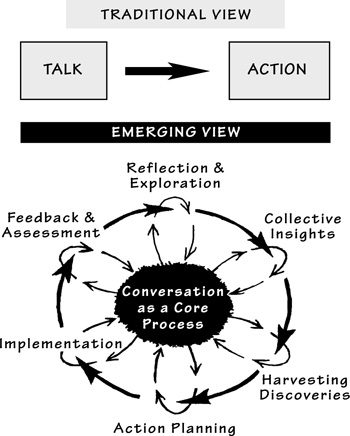
The initial and guiding thought came from Ben K, “I would have to see action and progress - one of the Achilles heels of this kind of thing is a lot of talk - when talk is detached from action, it's detached from reality”, to which I wrote and came to believe that we needed, "More insights - we need action, but sometimes we need spaces that give us a sense of connectedness and foundation - the change we're going for is so large, that we'll need that connectedness to help us reach the tipping point."
Also agreed with others who called for the need to, "Transcend the duality - Iteration and integration between talk and action. What of our actions have worked, and what have not worked? Blue sky thinking valuable, risk of getting stuck in it, thus the need for integration.” Also, the need to, "Be in ‘dialogue' with the world/reality."
For myself, the primary inspiration was the possibility of collective thinking bringing people together to face wicked challenges through both our technology and our deeper understanding of community and change. Crucial to that success though was learning how to govern our communities without being entrenched in our current systems of government institutions and political power.
The next World Cafe session on January 6, 2015, increased to a total 20 separate spaces for conversations and went for three rounds. Round One Room 14 for World Cafe discussed the assigned topic, "What is alive in you that could pay a role in what we need to discover and do?" which was a bit touchy-feely for my taste. In the conversation, I admitted to being, “More comfortable with ‘hard’ system practices such as visual diagrams...using Causal Loop Diagram and other relational maps and finding ways to bring hard and soft practices together in community governance venues/practices.”
The touchy-feely aspect came forward more so with, "The energetic vibration of love. Curiosity...engaged in a research project on ‘love'--finding the language of love--seems like ‘love' is following me." , put forward by fellow DDST community member Heather T., who called herself and seemed a definite INFP, and who was interested in creating a thriving, resilient local food system.
Heather, although coming from a noticeably different psychological perspective zeroed in on what I also saw as one of the primary challenges facing us. She raised the issue, “How do we speak to the differences we are (e.g., Meyer-Briggs, etc.) or other ‘groups’ (e.g., Tea Partiers)?” and later “Am sensing something biased by personal choices--seeing opportunities that are showing up and the ‘larger’ crises; seeing my connections and where I have traction. How to invite/relate to those who are ‘different’; see who shows up in front of me as ‘different'...don't go looking for them—“
From my own vantage point, I contributed that, “Empirical evidence shows that attempting to convince people that they are wrong in their views only makes them hold on to them all the more firmly. Our current systems, especially in political governance is competitive, winner take all. As Linda says, (in prior introductory comments) many feel unable to contribute because they don't see themselves as experts, a perspective often encouraged by institutions. “
For Round Two Room 20 for World Cafe on Jan 6, 2015, the topic was:
Imagine collaborating on some thrilling initiative that is making the difference we most need...
As each round of a World Cafe brings new people together, I mentioned again being a retired redevelopment project manager, this time though to assert some credibility in stating that many practices by governments were detrimental to community governance and that I was instead looking for more participative community paradigms.
The conversation turned to the concept of WE space. Heinz P., a German living in Canada asserted, “The WE space will tell us what to do”. To which Rachel E. asked, “Can you unpack WE space?”
It involved, we were told, inviting higher consciousness to see from where the calling was based on an (EVOLUTIONARY COLLECTIVE) that we are going into as a whole system, space which wants to evolve. New ways of doing things have to come from that space, not individual space.
This raised some others of my ongoing perspectives.
“We try to create new systems but entrenched systems must be addressed at the same time. Find systems of disruptive innovation to move from scarcity to abundance (as asserted here and here). Clayton Christensen at Harvard has a theory with commonalities. Systems of control and power that have a pretense of democracy need to come up with new ways to break the stranglehold. Not just disruptive but also innovative to give people power they need to make changes.”
Heinz raised the possibility of, “Working nonlinearly? Unexpected possibility not normally available to us?”
My response, “Yes, entrenched manipulative power keeping things from changing can be overcome by means which creativity is opened up ... creation and destruction seem to go together…"
Heinz, “Creating, which I'm excited about. Shiva is creative and destructive at same time. by dancing!” Which the group seemed to agree was a "Great metaphor for complexity."
Jeff A. introduced us to the, "Two Loops model by Meg Wheatley and Deborah Freize and friends has great value for people understanding the systems change that they are in, and how to be allies with others who are working in different aspects of the old system dying and a new system emerging." It is explained more fully here by this Two Loops: How Systems Change video and is based on the Berkana Institute Our Theory of Change arising from the article Lifecycle of Emergence - Using Emergence to Take Social Innovations to Scale, by Margaret Wheatley & Deborah Frieze, 2006.
Round Three Room 31 for World Cafe on Jan 6th, 2015 asked, ”Sensing into everything you've said and heard, what's taking shape here?"
Neither I nor Heather T., who ended up again with me in this round, were as of yet not seeing what's taking shape as it was so big and complex and would we felt take a few days of reflection. I am still reflecting.
Unfortunately, I had to miss the January 29, World Cafe for DandDTrans. There were two conceptual bridges used to begin to tie together the diverse variety of ideas presented so far. The graph below taken from The World Cafe by Juanita Brown and David Isaacs, and Fungi as a metaphor for DandDTrans, created by Ben Roberts, who was the primary force behind the DDST Community. Metaphor played an essential part throughout the engagement.
Monday, August 4, 2014
Systems Thinking - Sailing through Wicked Problems on Complex Seas
Systems thinking helps us not to be so dependent upon linear thinking when addressing complex challenges. This sometimes means skipping ahead then coming back which is the course I am taking in completing the STW/STiA Systems Thinking Certification course, skipping over the segment next in line.
The final two segments then, prior to certification, introduce us first to different dynamic systems and then to different soft systems methods. Both were referenced before as part of Michael C. Jackson’s System of Systems Methodology (SOSM) framework in the post Enabling a Better Tomorrow through New Community Paradigms via Systems Thinking. Jackson, as he explains in Critical Systems Thinking: Beyond the Fragments sought to, "relate developments in systems thinking to an increased sophistication in coming to terms with extreme complexity and an increased awareness of difficulties posed by the divergent values and interests of stakeholders."
Under Jackson’s classification, both dynamic systems and soft systems can be used to address simple, which we will skip over, to complex situations in which there are a large number of elements and subsystems with loosely structured interactions which can be non-linear. The difference is that soft systems are used when working with pluralist stakeholders meaning basic interests are compatible though participants do not share the same values and beliefs while dynamic systems are used when the participants are unitary in outlook, meaning the stakeholders all have similar values, perspectives and interests, at least on the relevant issue.
Soft Systems Methods are generally employed for purposes of exploration and understanding, to obtain a compatible vision. Dynamic Systems Methods are typically employed for improving goal seeking and viability, once a compatible or finally determined upon vision has been obtained. Both could and should not only be used with systems of direct participatory democracy, they should usually be used in tandem. This would be in keeping with an often cited concept that, “all hard systems are embedded in soft systems”.
As Dr. Mike Yearworth explains though in Hard Systems and Soft Systems this statement does not fully capture the differences between the two systemic approaches. It is an epistemic shift, as described by Peter Checkland and Susan Holwell that defines the differences between hard and soft systems perspectives.
Soft systems treat the definition as a question of epistemology, as in what can we know or find out about the world? While the hard or dynamic system takes a more ontological approach. Yearworth provides a chart with bullets on the differences between the two approaches.
There are many concepts and theories that embrace a Soft Systems perspective and are useful for exploratory purposes to attain a greater understanding and potentially draft a compatible approach to the wicked problem. Appreciative Inquiry, Idealized Design, and Soft Systems Methodology are three offered in the segment because they each have a well defined approach for their use. These will be examined more closely in the future.
System Dynamics and Viable Systems Model are two dynamic systems featured in this segment because they also have a well defined method for using them. Dynamic systems and in particular Systems Dynamics is where the process can get all the more concrete. Systems Dynamics, a field also related to Cybernetics, goes beyond Systems Thinking which can be seen as a relatively qualitative modeling system. System Dynamics, in contrast, is a rigorous methodology employing the development and use of formal computer models based on three components which collectively define it.
- Apply the accepted system dynamics theory of structure;
- Are constructed following the scientific method; and
- Use best practice tools and techniques.
The most adept advocate for Systems Dynamics is its creator, J. W. Forrester, Professor Emeritus of Management System Dynamics at MIT who upended the conventional thinking in management and redefined what growth means through articles such as System Dynamics, Systems Thinking, and Soft OR and Learning through System Dynamics as Preparation for the 21st Century. Professor Forrester has been deemed The Prophet of Unintended Consequences.
Another dynamic system, Viable Systems Model (VSM), developed by Stafford Beer, could be considered more abstract.
"It is an organizational representation of the elements and interactions considered essential for any system to be viable or autonomous". It is therefore not a method or process but a model of:
“A viable system being one that is organized and operates in a manner such as to survive in its changing environment. Adaptability is one of the prime features of systems that survive. (Adapted from Wikipedia)”
Beer, himself, narrates this video explanation on the Basis for the Viable Systems Model from Javier Livas - YouTube page.
A primary foundation for the Viable Systems Model is Ross Ashby's Law of Requisite Variety, or as is sometimes paraphrased," only complexity absorbs complexity”.
"The Law has many forms, but it is very simple and common sensical: a model system or controller can only model or control something to the extent that it has sufficient internal variety to represent it."
Arguably #3 of Clemson’s Systems Laws considered valid for all complex systems (Clemson seems to have added more laws. Kauffman also came up with a set of rules of thumb for complex systems as viewed by systems thinking. My suggested rules for community complexity are here.)
This could then be applied to Beer's environment, process and management as explained in the video, which would suggest that enhanced participation by community members would make the process more viable and sustainable from a community point of view.
The system though only has to survive, it does not have to reach any predetermined goals that we desire or that we may expect from the system. An entrenched city hall, often mentioned on these pages, can then be a viable system highly resistant, internally, to attempts to change it, externally.
The challenge and the need for some type of virtual systemic inquiry are that complexity is inherent in all phases that should be undertaken by communities addressing a wicked problem. Not only the phases are complex, the transitions are complex. To simply understand a wicked problem is a complex challenge in itself as demonstrated by this Ted Talk by Gavin Schmidt, The Emergent Patterns of Climate Change. The next phase is understanding and developing an agreed upon approach to address the wicked problem. The final stage is implementing that program and ensuring that it creates the desired results.
If it does not then it means moving back to a previous phase. Perhaps the vision created in the second phase was not as unified or compatible as thought. Perhaps it was realized that a significant minority did not support the plan but it was not appreciated how important they would be in implementation. It could also be that the wicked problem system was not as well understood as it needed to be to come up with a viable strategy that was not only devised as compatible through collaborative efforts but could be implemented through collaborative actions. One question then is how viable over an extended period would a winner take all strategy be under such an approach?
The bigger question is how the community manages the complexity that arises in addressing the wicked problem from its own actions when complexity is seen as a massive problem in its own right. Systems thinking provides different means of navigation, with different ones better suited to the task at different times but these means often tend towards the abstract and more concrete means are needed to sail these seas. What is needed are more concrete tools of collaboration, compasses and sextants applied to systemic inquiry and these days it needs to include the virtual sea of the World Wide Web. Looking to the development of such a system is the next (previously skipped over) segment.
Subscribe to:
Posts (Atom)