This blog is part of an online learning platform which includes the Pathways to New Community Paradigms Wiki and a number of other Internet based resources to explore what is termed here 'new community paradigms' which are a transformational change brought about by members of a community.


It is intended to offer resources and explore ideas with the potential of purposefully directing the momentum needed for communities to create their own new community paradigms.


It seeks to help those interested in becoming active participants in the governance of their local communities rather than merely passive consumers of government service output. This blog seeks to assist individuals wanting to redefine their role in producing a more direct democratic form of governance by participating both in defining the political body and establishing the policies that will have an impact their community so that new paradigms for their community can be chosen rather than imposed.


Showing posts with label deliberative democracy. Show all posts

Sunday, May 26, 2019

Hydraulics and Community from an ABCD Perspective

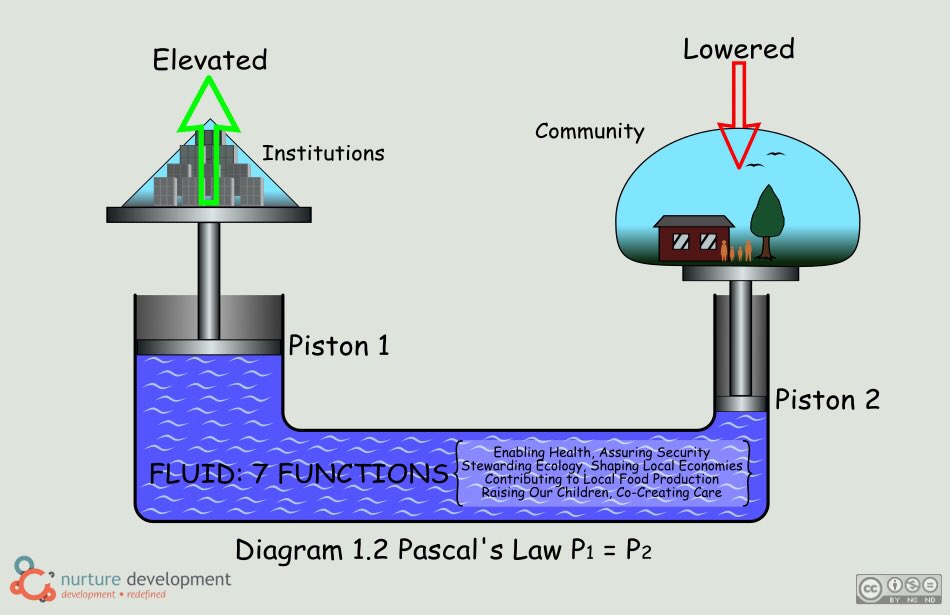
The latest NCP effort wasn't a blog post, it was a Kumu presentation of a systems map based on this infographic.


There have been different versions.
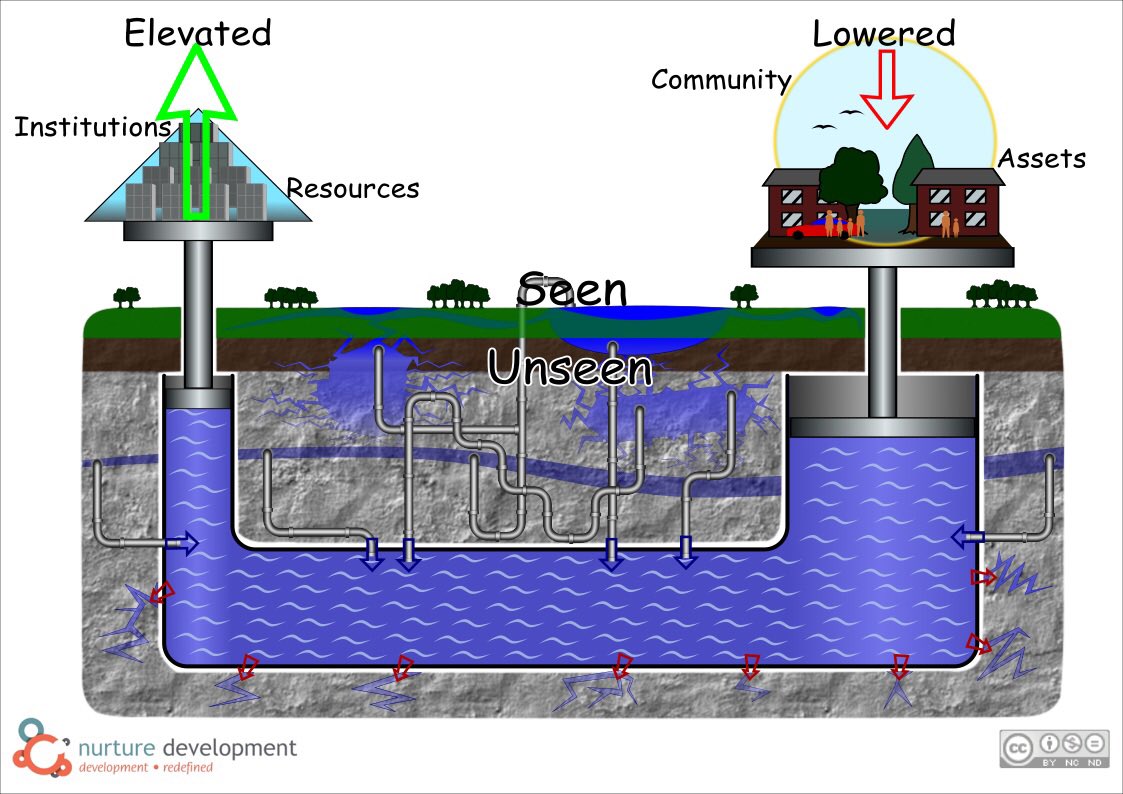


The basic idea though is that if Community Assets are lowered then dependency on Institutions or Institutional Resources is elevated. The infographic was the creation of Cormac Russell, who has been featured in this blog and NCP Asset Based Community Development wiki-page several times. 

Cormac discussed the infographic with John McKnight, who I feel safe in calling one of Cormac's mentors, in the video below, which is part of this Nurture Development Post, The Hydraulics of Community Power


Their conversation is a little over half an hour long but the amount of information and insights contained would take far longer to fully unpack. This writing, to which I am not laying any claim, is what I found to be the important points. Hopefully, this synopsis correctly conveys the pertinent facts and authentically retains their expressed perspectives.

The basic idea as presented by Cormac and John is that a hydraulic mechanism in its simplest form is a closed system, pushing down on one part of the mechanism another part has to go up by necessity. Similarly, as a community is performing its functions and institutions are performing their functions, if you push down on one then the other will go up and if you push on the other the reverse happens through processes largely unseen and often not understood. The hydraulic relationship provides an important insight in terms of the power, asymmetry of power dynamics between communities and institutions.

The image is further meant to convey a concept to which should be easily attested, that people know that in most neighborhoods people are not as connected as they would have been 50 years ago and raises the question, why and what are the ramifications?

Cormac and John provide examples of components of community life, education, public safety, and health that have been expropriated by institutions or appropriated by them through the acquiescence of communities, invariably implicit as nobody votes for it. Bringing people to think that more police equals more safety or that more hospitals equal more health.

The state of the educational systems in the US can be explained to a great extent by the multiple community functions taken over by schools. Eighty-five functions since 1900 according to the book, ”Schools Can't Do it Alone.” The educational institutions have been expropriating community functions that have fallen mainly on the shoulders of teachers, a clearly crushing responsibility at which they are doomed to fail.

Police Departments are struggling with the problem of not having the members of the community involved, as though they had nothing to do with the issue of security and safety. More enlightened Police Departments have come to understand that the connection isn't simply about getting the community to call the police and report on their neighbors. There is a very clear community function around the production of safety. It is an association or function of community life itself. Neighborhood policing has become much more about community building and less about enforcement and informing.

At the same time, Police Departments and other institutional entities are still defining themselves and justifying ever increasing budgets by consistently saying we need more money to deal with all these different problems.

Medical practitioners cite similar relationships in health to those around education and safety with eighty-five percent or even higher of what determines well-being having nothing at all to do with clinical or pharmacological intervention or anything that a medical professional can do to us. Most of what counts for the healing of suffering happens outside the medical institutional realm. One primary care doctor, a public health practitioner who runs a primary care facility said that forty-five percent of the people who come into his surgery is not biomedically ill. They're lonely, disconnected in some way. A word for their condition is isolated, they are in a sense alone. Perhaps they have some moderate challenges in socializing but technically they're not sick. They need commune they don't need a doctor.

The growth of loneliness in modern societies has been increasing even though we see ourselves in cities as all collective. Our loneliness, according to Cormac has been growing as we left the more rural areas. In Vancouver, Canada a foundation gave a list of about 40 issues and asked residents to rate them and the number one issue was not crime or education but loneliness. What we're seeing now is the rise of programmatic interventions around loneliness. Loneliness has now become the new pathology that is being targeted with programs by institutions.

This erosion has come through the evolution of consumerism. It is a shift to an idea of a consumer society in which one could buy what one wants to be produced, being individuals who took that responsibility out of our community and put it into the marketplace. It's the consumer economy built on the assumption that we can outsource these at one-time community functions to the institutional realm so that we can get on with being consumers.

Marketing and media, over and over again, are trying to persuade us that it is better to buy a life than it is to live one. Advertising things that will be done for money that we would never have seen in the past done for money.

We now turn to institutions to buy through taxes and charitable donations solutions for the issues we face collectively but that shift in culture is problematic because so many of those functions are ones that only people in face-to-face relationships with each other can really perform effectively.

We have been handing over functions at which we are most competent and most capable to perform. The institutions are appropriating all of these new functions, yet they are overburdened and are less able to do their actual legitimate functions becoming a collective equivalence, as Cormac noted, of the Peter Principle where institutions are elevated to their own level of incompetence.

City leaders, responsible for dealing with these issues want their residents to see local government as trustworthy and know that it can be relied on but all too often in their minds the role of the citizen is defined as that which happens after the important work of the professionals is completed. This is a perfect example of a hydraulic relationship. The role of the professionals goes up, the role of the citizens goes down. This is an inversion of democracy for it needs to be the case that the role of the professional is what happens after the important work of the citizen is complete.

Cormac and John then asked how does the institutional realm lead by stepping back? How do we locate some of that appropriated authority back into community life again? How can we resurrect the community in taking on the functions that are the strength of the social contract of neighborhoods in our towns?

John thought of it as being almost forceful in nature on many institutional leaders because of their accountability and defining trustworthiness. That what they could do is get folks, people in our communities, to see that our institutional people, in our schools, at our police departments or hospitals, are at their limits, in truth over their limits, and are becoming counterproductive because of all the functions we have given them.

The alternative is stepping forward into our own power, our collective cultural power with the agreement that through social contract there are certain things teachers, police officers, and healthcare professionals are not going to do. Responsibilities that we decide to take back as community.

Cormac and John also provide three successful examples of taking back responsibility for collective functions of, by, and for the community.

The manager of a large housing development in Sweden sent out an invitation saying if are you lonely come next Tuesday to the dining room and we'll have lunch together had eighty-some people show up. The manager was able to succeed because he had support from community builders in the neighborhood in addition to connectors who were also at that lunch, as well as welcomers and askers in the neighborhood.

Another example Cincinnati Starfire, a workshop placement for people with intellectual disabilities that reimagined its role through its participants and became an enterprise space where local small businesses pay rent and establish small pop-up offices in which they operate. More importantly, participants are also out in their own neighborhoods with resources and money that they can spend effectively becoming community builders who are contributing to their neighborhoods. The professional staff is also out in the neighborhoods with them, supporting them, supporting relationship building so they too are core community builders.

Then there was Henry Moore, the assistant city manager of Savannah Georgia who sent a letter to the people in the lowest income neighborhood asking them to write a letter no more than one page saying what they would like to do to improve their block and have two other people sign it who will also do it with a maximum grant of $100. The first year he got eighty requests with very little money spent. From an institutional point of view, it was one of the most incredible ways of beginning the change of the hydraulics system. He was saying to the community, you have all kinds of functions that you can perform. How do we support you? He also said We (the City) are not going to do work, the community took up the challenge and they did they work. In the past, investment had been put in from the top through Community Block Grants. ”When I had the block grants that made almost no change but when I led by stepping back and provided the incentive for citizens to be producer things changed”.

Below is the Kumu presentation looking at the same subject from a Systems Thinking perspective.
The next post will examine some of the differences.


Sunday, April 21, 2019

ABCD and Community, a Systemic Analysis pt 3

This post will continue with the development of concepts presented in the previous two posts of this series.I raised my own limitations regarding Systems Thinking and especially Asset Based Community Development (ABCD) in the first post. This post has an additional limitation for this series regarding the scope of this analysis. It only deals with ABCD from a limited perspective. ABCD is far richer than what is being presented here, similar to using the Logistic Equation to explain changes in population, hopefully, useful but only a sketch.

Asset Based Community Development or ABCD seeks to define an ideal relationship between institutions, including the agencies through which policies are implemented in pursuit of their mission, and communities, particularly what has been termed colony communities or marginalized or dependent or so-called hard-to-reach (HTR) communities.

As Cormac Russell has said, the carrying capacity of a local community depends upon good stewardship of that community’s welfare ideally requiring the correct sequencing of nurturing at three levels to discover the community’s underpinning capacities and in a way that does not function to harm the social capital of the community. The result of such good stewardship in times of crisis should be sufficiency and the potential for greater abundance, not scarcity and abandonment. These three relationship levels, however, presume a benign power relationship or better between community and institution.

The first level is recognizing that there are things that communities do best on their own without institutional assistance. This requires asking though, what are the things that only residents/citizens can do in response to an issue? These should be determined regarding the strengths of the community, not its deficits.

These are the things for which a community already has the adequate inherent carrying capacity to do best on their own though this may not yet be realized. The efforts are purposefully applied by the community and should not be supplemented by purposive institutional programs. Any involved agency is hopefully facilitating these efforts to help make the efforts more efficient and helping to remove barriers not creating them. This though cannot be assumed.

The second level is recognizing that there are things that communities can basically do themselves but with some help from outside agencies. This level is beyond the carrying capacity of what a community can do solely on their own but could perhaps do with some help from an outside agency.

The carrying capacity of the community is not fully adequate to the task either because the extra needed capacity to some extent remains external or is inherent but has not been fully realized. What then are the things that residents/citizens can lead on and achieve with the support of institutions and their agencies (governmental, non-governmental, for-profit) in response to that issue? As important, can those agencies be expected to provide support to the community in doing what it can’t do for itself?

If so, those outside agencies should then ideally facilitate such activities so that the carrying capacity of the community goes as far but no further than is sustainable. Outside agencies should seek to be in the right relationship with communities and provide proportionate support that does not displace or diminish community power.

The third level is recognizing that there are things that communities need to have done for them by outside agencies. The required carrying capacity is both external and unrealizable by the community. The questions for the community then are not only what are the things that only institutions can do for us (residents/citizens) but as important, what can the community do to induce the agency to do for the community what the community can’t do for itself.

The agencies should then seek to do those things in as transparent and accountable a manner as possible but the scaling required to address the issue may be imposed on the community rather than induced by the agency.

The Nurture Development post, What We’ve Tried (in isolation) Hasn’t Worked: The Politics of Community, raised questions that need to be answered by or for a community so that the locus of control over a community’s carrying capacity is by the community, not an outside institution. The factors defining the three levels of relationships between communities and institutions can be expanded to enlarge the overall community based social carrying capacity.

The community needs to develop the extended carrying capacity or social capital to be able to determine:

  • What are the things that institutions can stop doing which would create space for resident action, enlarging the community social carrying capacity?
  • How agencies can create space for the community to grow in that capacity, moving from dependence to self-sufficiency and independence.
  • How the agency can determine, what the agency can do to go beyond its current level of community support?
  • What can institutions start offering beyond the services that they currently offer to support resident/citizen action?
The institution examines its mission or purposive functions or better the community purposely examines and redefines the mission of the institution to provide unrealizable and external but needed or desired carrying capacity and enhances the previous three levels of relationships.

The community often either does not have the carrying capacity or social capital on its own without help which is either never offered or if given can be threatened so that the institution and those who benefit maintain control. This means purposefully enhancing the inherent but yet still unrealized carrying capacity of the community to add to its needed social capital. It is difficult seeing this done through the purposive actions of an institution. A call for an institution to unilaterally remove barriers that it put in place would seem to argue against that community having sufficient carrying capacity on is own to scale to the next level.

The institutions are expected be to either move the community to a greater sense of inherent and realizable carrying capacity or to accept responsibility for external and unrealizable but still desired carrying capacity as part of its mission.

This requires a purposeful systemic change for which whether at first internally realized or unrealized is likely initiated through external carrying capacity if only as a catalyst. A required a change in the power relationship between the community and institution, an enhancement in social capital or the type of carrying capacity utilized by the community from direct and independent with the community directly doing things on its own to more indirect but controlled, things are done through an agency but the community holds greater control.

Cormac has pointed out that the power relationships of communities with outside institutional agencies have changed over time with institutions claiming that service delivery is neither sustainable nor ironically empowering. Austerity, defined by these institutions and implemented by agencies, means the communities now have fewer outside resources available so have more of the responsibility for maintaining carrying capacity, including taking over care of those who are highly service dependent, which is again a form of harvesting of that community's carrying capacity.

A question then is who specifically is the "We" whom Cormac speaks of that needs to learn from communities what they can do and care enough about to do with or without outside help. Who is the “We” that not only helps communities determine what they can do with some support, and only then helps in determining what external resources are needed but also helps in negotiating with the government institutions or enhancing the carrying capacity of the community to do such on their own?

Now I know that the answer is us, being both the enemy we have met as well as being the ones that we have been waiting for. The devil though is in the details. Direct democracy, in some form, combining both participatory democracy, emphasizing ABCD and deliberative democracy, emphasizing Systems Thinking is one potential path to needed new community paradigms.


part 1
part 2

Friday, February 8, 2019

NCP Inquiries into Systems Practice - 10th post of 3rd Project

This is the tenth blog post in a series on the Jerusalem Vision Project, which is the third Systems Practice project undertaken through the Acumen course using the Omidyar Group’s approach to pragmatically applying Systems Thinking

The project took my rudimentary knowledge of Systems Thinking as a basis for obtaining a better understanding of Systems Practice and applied it to a complex challenge - Israeli/Palestinian relationships in the City of Jerusalem of which I admittedly knew relatively nothing.

This specific blog post is going to again review this endeavor, not of achieving better relations between Palestinians and Jews in the City of Jerusalem but in the utilization of Systems Practice to address such complex challenges. These points have been made before but across disparate posts making their assertion somewhat disjointed.

These continuing endeavors seem to have worked well in attaining a better understanding of the Systems Practice methodology having initially made a late start in properly applying the methodology the first time with an inquiry into food trucks for homeless camps but still having concerns about the process afterward nonetheless. The second time, looking at plastic pollution of the ocean in Bangkok, Thailand, gaining a better understanding and a somewhat more successful application but still having questions that remained or continued to be needed to be tested to confirm certain aspects in terms of how Systems Practice could be utilized in developing new community paradigms.

The difference then between this Systems Practice project and the previous two projects is first, a better understanding of how a Systems Practice approach works and second, instead of focusing on each project step by step this project waited until completion to get a better overall view of the process. Both to determine how the Systems Practice process unfolded and to assess how Systems Practice might be integrated with Direct Democracy and Systems Thinking.

However, endeavoring to absorb the entire process after its completion raised a number of complications particularly when attempting to communicate the worthwhileness of the effort with anyone who has had little to no experience with Systems Thinking or Systems Practice. It is not a difficult challenge to get those interested in Systems Thinking or Systems Practice to take a look at another example of the methodology to either agree with or disagree and critique. You can simply ask them, the community is especially helpful.

It is more of a challenge to get those neck deep in dealing with real-world messes to consider Systems Thinking and Systems Practice as viable approaches to finding solutions. This takes us back to the first paragraph. Any contribution I made to specific projects was not based on my first-hand knowledge of the particular challenge under consideration but my relatively better understanding of applying Systems Thinking and increasingly, a Systems Practice approach to these challenges, in cooperation with others who had committed to trying to apply the approach with their enrollment in the course.

The Jerusalem Vision Project had its own particular challenges being based on both more complicated and conflictual issues, in addition to its complex nature. Complicated and conflictual because of political and historical reasons but also somewhat internally conflictual, though collegiately so, because of distinctions between different mental models used by the project participants. The complex nature of the challenge though may not be as readily apparent because of the confusion arising from the complications and inherent conflict.

While I feel confident that those with whom I went through the three Systems Practice projects found it beneficial, this is harder to convey to those who weren't brought to such efforts for their own reasons. All the harder as both Systems Thinking and Systems Practice can be conceptually abstract when people are often anxious for so-called concrete solutions.

Systems Thinking provides a logical construction in finding solutions but is not always explicitly empirically evident. Further complicating the matter is that Systems Thinking, though it has certain foundational aspects, can be categorized by different approaches and underlying philosophies that seemingly conflict. Conceptual conflicts by Systems Thinkers, seeking a solution to be imposed, that may sometimes be made too readily the crux of the matter rather than the detrimental impacts of the challenges themselves.

This can obscure the viability of System Thinking’s fundamental principles but it isn't the primary hurdle to convincing the uninitiated to make the commitment to a Systems Thinking or more specifically a Systems Practice approach which can be substantial.

The primary hurdle is an essential change to a mental model that is linear, analytical, reductionistic to one that incorporates a perspective that is also non-linear, holistic, synthetic. The basis and need for the change and resulting implications can be easily underappreciated while the siren call to grasp at an immediate concrete solution can be addictive. The basis for this distinction and requirement for convergence is explained, more succinctly than I can, by this video from Complexity Labs.

The Acumen/Omidyar Systems Practice approach overcomes this hurdle by having its implementation be dependent upon the convergence but not explicitly so. It follows the logic of some Systems Thinkers that like Fight Club, Systems Thinking shouldn't be talked about. It does lead those who habitually follow a path by reductionistic, analytical, linear thinking so often used by command and control top-down management to the alternative of thinking defined by synthesis, holism and non-linearity without making the transition too obvious.

The Omidyar Group’s approach to Systems Practice though does not only steer most participants, whose primary experience has been following that habitual path to an alternative one but also navigating those supposedly versed in Systems Thinking away from too quickly determining a final path to a solution to whatever complex challenge is being faced. This was my error with the first Systems Practice project, to immediately begin mapping towards a solution.

While the course does present the case for synthesis and Systems Thinking in a general sense early on by examples, it instead takes participants through a number of steps that unless used and tested can seem contrary to how we usually approach such challenges even when using Systems Thinking as individuals. While their purpose may be explained with each step taken, their cumulative effect cannot be fully appreciated until more fully implemented. Until that occurs participants are encouraged by the course to have trust in the process.

What the Omidyar approach does is take the internal, and usually implicit mental maps of each of the individual participants regarding the system in which the mess or complex situation occurs and asks them to hold it in abeyance then work to first create a common goal through the Guiding Star, Near Star and Framing Question. More importantly, though, is a process of disaggregating those individual maps by collecting the factors making them up without any of the connecting relationships unique to each.

This collective set of factors is then jointly categorized as being either enabling or inhibiting and then rearranged into new collections defined by common traits or themes. This process helps not only to open up pathways to the internal mental maps of individual’s that may have been previously closed but also sets the basis for finding a set of new and collectively determined relationships. This arguably has a far stronger basis for democratic deliberations. At no point in the process so far has a systems map or map of any type been started. This took some personal adjustment.

The next steps in the Systems Practice process, upstream and downstream relationship configuration and S.A.T. (structural, attitudinal, transactional) Analysis were touched upon for the third time in recent posts. Despite having my own ideas on S.A.T analysis and its implications, I have come to appreciate its viability in contributing to the process, having been able to anchor it to basic Systems Thinking concepts such as the Systems Thinking Iceberg model and integrating it into basic Causal Loop Diagrams.

However, it needs to be admitted openly that Systems Practice does not provide a panacea. Surely no surprise on its own but it is important to be clear on why. The first goes back to the beginning of this post. I may have made an abstract, conceptual argument for the viability of Systems Practice but in the meantime, I completely abandoned the challenge it was supposed to address - Palestinian/Jewish relations in the City of Jerusalem.

The individual embedded in the system of concern, be they Palestinian or Jew, needs to be convinced of the viability of the process. That has not been accomplished except perhaps for a few individuals. To be even more honest, none of the projects undertaken so far came up with a final answer to their challenge. These were, to be fair time restricted, limited, basically academic projects taken on by groups of strangers globally separated by different time zones. In those cases were doing more was sought out, the complications and often stochastic nature of the real world hampered such efforts. On a broader and long term basis the challenge though is one of implementation and the problem is a Knowing-Doing Gap discussed in previous posts.

Despite these limitations, I have become convinced that Systems Practice can make a valuable contribution to creating new community paradigms. I recognize though that my rationale as presented will have little potential to influence those living with complex, wicked challenges without at least addressing those challenges more directly. I will attempt that in the next post.

Thursday, November 29, 2018

Framing the Systems Practice Framing Question

The last blog post dealt with the Systems Practice Guiding Star and Near Star, both of which are future-oriented. This post will deal with the related Systems Practice idea of a Framing Question. A Framing Question focuses on understanding the system to be analyzed in its current configuration and to be ultimately affected to bring about the Guiding Star.

At this point, we are beginning to seek to understand what creates the forces which maintain the system in its current configuration, without passing judgment on either side. By understanding these forces we may then hope to leverage some of them to move the system towards our Guiding Star. How we do that will be based in part on how we format the Framing Question:

1.  One way is to ask what are the forces that affect the ability to improve the system for everyone?

2.  Another way is to propose you can’t understand how something enables or inhibits a healthy system unless you understand fill in the blank.

However, as one objective is to potentially incorporate Systems Thinking and Practice into democratic processes this post will also deal with framing from the perspective of democratic deliberation though more through Governance through Community rather than elected representatives. This takes the Framing Question a further step as well as expanding its inclusion.

The Kettering Foundation, as part of Governance through Community, recognizes that one of the biggest challenges facing communities is developing the capacity of Working thru Difficult Decisions. Because ostensibly, "Deliberation seems like neurosurgery or something only an outsider can do” this can make some fearful of attempting it.

”The Kettering Foundation has found that sound decisions are more likely to be made when people weigh—carefully and fairly—all of their options for acting on problems against what they consider most valuable for their collective well-being. This is deliberative decision making. It not only takes into consideration facts but also recognizes the less tangible things that people value, such as their safety and their freedom to act.”

Their suggested approach is Naming Framing Difficult Issues for Sound Decisions

”The obvious question is, what would motivate citizens to invest their limited time and other resources in grappling with problems brimming with conflict-laden, emotionally charged disagreements? Generally speaking, people avoid conflict, and they don’t usually invest their energy unless they see that something deeply important to them, their families, and their neighbors is at stake. And they won’t get involved unless they believe there is something they, themselves, must do.”

”These differences don’t necessarily become divisive, however, especially when people recognize that although they don’t share the same circumstances, they share the same basic concerns. In deliberative decision making, people can see that they both agree and disagree. This encourages them to agree to disagree and lessens the likelihood of polarization."

The National Coalition for Dialog and Deliberation (NCDD) asked the question “How might we make our D&D work more equitable, inclusive and empowering?” One of their objectives involved Framing which for them meant ensuring that the community is the key framer of the issue(s).

This was seen, however, while a civic issue, not a priority one. It was connected by systems maps through (Kumu) clustering to similar concerns from the categories of access, trust, and barriers.

The priority NCDD issue to which it was connected was “Celebrate individuals who have opposing views rather than attempting to marginalize them”. Taking their concerns of equity, inclusion, and empowerment to an individual human level.

Another resource, the Community Tool Box, by the Center for Community Health and Development at the University of Kansas, featured in Community Tech Tools and Healthy Cities pages of the NCP wiki discusses framing and reframing more in terms of initial implementation, having the idea accepted.

Frame a powerful question”, a Deloitte Insights article, has us ask questions that focus on the learning opportunity and that can provoke and inspire others to change the game for longer-term results.

The following are the Framing Questions for the last three Systems Practice projects. Each is uniquely associated with its particular project but they also differ in their scope and boundaries as well as whether they focus on institutional factors or are more people focused.

For the “Last Mile Food Truck Feeding the Unsheltered Homeless” project the Framing Question was:

“What are the factors and their relationships in the "Access to Food(Healthy) system" and in the environment that are lacking for the homeless population and that would determine the real impact of the food truck on getting people back into the community once introduced?

As part of this question we will also be asking:

1. What prevents those struggling with homelessness from accessing available Food(Healthy) resources?

2. What prevents Food service providers from accessing their target demographic (homeless, or those who are unstable and threatened with homelessness)?”

For the Plastic Pollution project, the team leader came up with the more succinct final version of the Framing Question.

”What forces account for the current levels of plastic pollution in Bangkok?”

Our course catalyst for the project, Yeu advised us:

“The framing question can be more targeted towards discovering the forces at the bottom of the iceberg, i.e. the beliefs and perceptions of stakeholders. Here in also lies the crux of the direction that your guiding star can provide”.

Tying it back to the Guiding Star and potentially expanding the inclusion of a greater number and diversity of stakeholders. If this can't be accomplished in the initial stages of the Systems Practice project, it could be at later stages even after completion of the course.

How you frame a system and how others see you framing it influences how those others will interpret it, even if you didn’t use either Systems Thinking or Systems Practice to build it.

In the blog post A Second Look at Neoliberalism with a Community Face and Asset Based Community Development, a particular Scottish perspective saw ABCD efforts as framing notions of civil society and citizenship as being separate and independent of any notion of state responsibility (though not removed from as the article’s authors state), thereby promoting privatization of public life. A position totally at odds with ABCD’s own perspective of itself.

Although NCP wrote in opposition to the Scottish perspective, it still demonstrates the importance of the Framing Question being asked of the system you are investigating, even after the Systems Practice course is completed.

Our Framing Question for Jerusalem Vision is:

“What forces encourage or discourage interaction, trust, and understanding between members of the different communities?”

Some of the factors involved in the system were framed as “Tribalism," which could be seen as controversial though it could be pointed out that tribalism exists in American politics and other areas of the world. As for framing the question within the current geopolitical situation our team leader Yoel, the only one of us to actually live within the system in question advised us to avoid pie-in-the-sky thinking as what we are addressing is a different model of rights/privileges/collaboration than found in the Western democracies.

“The West cannot come into the Middle East (e.g., Iraq) and expect a millennium of entrenched religious and social conventions to change overnight to mirror its Western cultural values and beliefs. There has to be a middle ground where the West's positive values meet the East's traditions, customs, and mores and find a synthesis that embodies the best of both worlds without relinquishing the benefit of either!”

Sunday, May 6, 2018

Systems Practice Crossroads, Is It Worth the Effort?

The current effort has come to a crossroads, so some territory will be gone over again. The purpose of this blog series on Systems Practice was not to persuade anyone unfamiliar to use either Systems Practice or Systems Thinking. The systems map displayed in the last blog post would have discouraged that, a collection of colored dots connected with swirling yellow lines. One might have discerned that the color of the dots corresponded with different categorizations, the Systems Practice themes and that the connection between different dots formed some type of relationship. At this point, it was merely that one dot (factor) was roughly upstream (cause) or downstream (effect) of another. The why, not only of individual connections but of the larger complex structure rising out of those connections is far less apparent. At this point, it would be impossible to unravel the myriad of decisions that went into that particular final configuration.

The effort was instead to test certain ideas that have been featured on this blog as well as to evaluate the Acumen Systems Practice course for a second round. The first round considered not to be a proper assessment since the program wasn't followed, jumping too soon ahead with systems mapping. The approach was undertaken again in an attempt to assess how Systems Thinking and especially Systems Practice could be utilized in a system of community governance based on direct, or both participatory and deliberative, democracy. Such an approach has been examined more theoretically with the blog post, A Map for Direct Democracy and Systems Thinking, related Kumu map, Direct Democracy and Systems Thinking and the Kumu presentation, Using System Thinking for Better Deliberative and Participatory Democracy.

Special attention was paid to how community groups might use Systems Thinking to develop projects and programs that could potentially be of benefit to the entire community. As an extension (or as an appendage of), a system of Community Based Virtual Collaboration was also explored in the blog post NCP + VSI = A Potential Path for Meaningful Community Change.

The crossroads is the transition from an upstream-downstream systems map to a more comprehensive Causal Loop Diagram map that more explicitly expresses the different multiple relationships making up what has been deemed a Plastic Pollution Production system, specifically in Bangkok, Thailand.

It would seem that while not quite as early as with the first attempt at the course, I still started systems mapping too early, at least there is an argument for such. I touched on this argument in the last post.

There may be two reasons for this splintering between what the course calls for and my own natural inclinations. First is my natural inclination to map a system in question to better understand it. Trying to conceptualize the upstream and downstream relationships of the collection of different factors we had collected together as a team would have been frustrating for me if I couldn’t map. Second, the Systems Practice approach seems to be more suited to teams that are physically in the same location.

Our current efforts were not a good example of Virtual Systemic Collaboration. With the Homeless Food Truck Systems Practice Project, the team members were primarily in the United States so time differences were less of a factor. Communication being not only asynchronous but also far more distant geographically made communication too difficult this time. The Homeless Project also had a larger team to start with, offering a greater diversity of ideas, and more people not only came up with ideas but also contributed their own systems maps. I worked both the group and, as mentioned before, had started with my own systems maps on the topic.

Arguably, I still started too early with systems mapping this time. My interpretation of the Acumen Systems Practice group approach is that far more time is spent on working with the factors as components prior to solidifying them into a system that can be mapped out. My contributions to the collection of initial factors regarding plastic pollution in Bangkok, Thailand were overly generic in my view. The others made far more precise and applicable contributions. I then took those and came up with the systems map cited above.

Analogies help understand the difference in approaches. I created a root system for the Causal Loop Diagram maps that I would go on to make. The more official Systems Practice approach seems more akin to building an automobile. Everybody in the group brings in what could be used as parts and discussed together how they could best be fitted together.

With the Systems Practice Homeless Project, I could argue that my individual approach was better suited for deeper analysis. Too often, from my personal perspective, online collaboration efforts try too hard to come up with solutions that satisfy everyone regardless of how inviable a solution it may actually be in the long term. Unintended consequences are deferred in favor of current compromise. Systems Thinking that stays true to its principles has a way of telling people what they often don’t want to hear. One, in particular, is how very, very hard it is to permanently change entrenched systems, especially entrenched, legacy derived, institutional systems or the systems arising because of them.

The creation of a root system for the Plastic Pollution Production system would likely define to a great extent the specifics of the type of system that would grow from it. Doesn’t mean what grows from it is wrong but it does limit possible and potentially better solutions. More maps using both the organic method and the construction method to be evaluated together would seem to be a better approach.

Unfortunately, the MOSS team was not able to hold together. Dohn at this juncture had decided to pursue his real world academic pursuits. Shawn joined too late after the Causal Loop Diagram maps had been largely developed, and as discussed in the last post felt unable to make any meaningful contributions. A result perhaps of having created a far too solid appearing system structure. Steve (and Sander) had been communicating that the projects which with they had been working were demanding more of their time. This Systems Practice project was only to be a possible part of that larger project for which they were responsible. My understanding was that the Systems Practice project was not the primary purpose. Both Steve and Sander presumedly then pursued their primary purpose and stopped participating in the Systems Practice project.

So I began creating the causal loop diagrams from the root of the aforementioned upstream-downstream systems map and continued on until it reached what I felt was a state (actually states) of completion. I continued to proceed in the effort despite not being able to obtain any feedback. Systems mapping becomes more of an internal process based on logically building upon previously established factors, connections, links, and loops.

Basically, what I was doing was creating a story or play based on the factors, let's think of them as analogous to characters, props, scenes in a play, given to me by the others. There seems to be a positive albeit passive acknowledgment of the story that was created. I received a few likes and positive comments but not really any critique.

Even with the best of intentions, there are a number of errors that can arise in developing a Causal Loop Diagram map intended to explain or elucidate some particular system or component of a system. I could have misunderstood the factors or could have placed them into an incorrect configuration. I could have gotten both correct but made wrong inferences when developing the relationships further.

Even if I am right in all of these aspects, my approach could still be suspected by many. My satellite-oriented vantage point of the larger system took, I believe, a Systems Practice perspective of looking at the system’s health rather than devising some path to mission accomplished, understanding the patterns comprising that system and endeavoring to find the means of change internal to the system rather than imposing from the outside. As I said elsewhere, “However, none of the causal loops directly cause plastic pollution as their intended purpose”. Three different systems, capable of existing independently on their own came to be seen as being subsystems of the larger Plastic Pollution Production system - Retail Market, Business Perspective and Governance Environment. (This effort has long held that there is a difference between government and governance.) Any perspective taken solely from any one subsystem vantage point might very likely miss insights required to understand the entire system.

This then brings us to the real question behind this effort. Is it worth it? Does systems thinking and its practical application Systems Practice make a difference that is worth the effort that a group needs to put into it? That question has still not been answered.

I create systems maps of any kind first as an explanatory vehicle for myself then as an explanatory vehicle for others. It is the later, explaining to others, that is obviously the greater challenge, especially for complex systems. Using Systems Thinking means that others must not only become familiar with changing from solely longitudinal thinking to also incorporating latitudinal thinking but also delving deeper into both the content and context of the system in question. People, however, often desire to be persuaded rather than to convince themselves by taking the time to develop a deeper understanding. A simplified and persuasive explanation often does not have the necessary explanatory power needed to understand how to make changes to a complex system that don't have detrimental unintended consequences. Understanding is easier if they have participated directly in building the relevant systems map. It can still be possible by taking them through a guided tour using Kumu presentations. The following presentation is the first attempt to find that balance, Addressing Plastic Pollution in Bangkok, Thailand - Essential Factors Pathway (Deep Structure).


Monday, May 30, 2016

Asset Based Community Development Lessons for Systems Thinking

In the last post, Cormac Russell, faculty member of the ABCD Institute at Northwestern University, Illinois, now DePaul University, Chicago, Illinois and Managing Director of Nurture Development, the leading Asset-Based Community Development (ABCD) organization in Europe, was introduced by this blog. He was contrasted with a more ‘Collective Impact’ approach to ABCD. In this post, we will look at the approach taken by Cormac and Nurture Development and contrast them with the approach taken by this effort, especially Systems Thinking. Such contrasts are more in the nature of different sides of a dice rather than mutually exclusive opposites. 

As was mentioned in the last post, Cormac seems far more likely to write about 'collective' in terms of, direct collective energy towards collective action or, a way that is inclusive and supports people to generate disparate energy into collective democratic power", rather than the often top down methodology of Collective Impact. A problem with Grasstop oriented Collective Impact is that citizen leaders can often be stuck in silos as readily as government departments can. 

At the recent TEDXExter 2016, Cormac gave a talk on Sustainable community development: from what's wrong to what's strong, arguing that we need to start with what's strong within a community instead of trying to right what we see as wrong. We can grapple with humanity’s toughest questions by helping people in discovering what gifts they have and using those gifts to enrich those around them and help people to define and to live a good life. For more background there is John McKnight Keynote Speech about the history, practice and future of Asset Based Community Development from the 2016 ABCD Festival and What is Asset Based Community Development? (in under four minutes)  (more videos).

Now the videos will provide you with a pretty clear, concise and complete idea of what Asset Based Community Development is and what it tries to accomplish, so if you are still reading and haven’t watched yet, you should. If you have watched then you might want to stop and reflect a bit then come back.

In Cormac's TEDXExter video, he uses a familiar term in Systems Thinking, 'unintended consequences'. In this case, of our current institutional, often bureaucratic attempts at helping people in our communities, listing four of them.

The first unintended consequence is defining people not by their gifts, capacities and what they can bring to the solution but by their deficiencies and their problems. The second unintended consequence resulting from a top-down obsession is that money doesn’t go to those who actually need the help.  Instead, it goes to those who are paid to provide the services to those who need help. The third unintended consequence is that active citizenship, the power to take action and to respond at the grassroots level, retreats in the face of ever-increasing technocracy driven by professionalism and expertise and finally. 

With the fourth unintended consequence, Cormac mentions another Systems Thinking term or tool, mapping. Entire neighborhoods, entire communities which have been defined as deficient will start to internalize an imposed a negative 'map' and believe that the only way that anything is going to change for them is when some outside expert with the right program and the right money comes in to rescue them these so-called unintended harms.

At this point, I may have a tendency to start having some different perspectives from Cormac. Before making too much of this though, I should state my own perspective that maps should be seen as raising questions, not providing answers. Maps are launching points for exploration, one can always provide more detail and deeper understanding or one can move beyond the edges. It is easy enough to take maps for granted which is invariably done all the time but that is merely intellectual laziness. 

A viable way to be collective and inclusive from the bottom up, according to Cormac and those with a similar mind set, is to work through the concept of the communal Commons to enable some type of Coalition of the Doing in determining the relationship between Capitalism And the Commons. Such an approach encourages communities to ask questions such as, does growth equal success? (Hint - no it doesn't).

ABCD has the capacity to encompass a rather expansive view of community. It can take a neighbor to neighbor approach as did Tamarack's Abundant Community Edmonton which is part of its campaign to work towards the promise of deepening community. It can also take an institutional city government approach, as with Our London is a city of Neighbourhoods, London, Ontario, Canada that is.

Cormac is concerned with institutions using asset mapping to build data about the assets of communities, like an inventory, instead of supporting those communities by first building relationships and then connecting the assets. Even so, he provided a practical and fun way to start a conversation about community assets without any theory. The point according to Cormac is remembering asset mapping is an inside job focused on relationship building not data collection. Similarly with Systems Thinking, it is the relationship between people and assets that brings about the potential for emergent capacities of the community. The challenge is keeping the focus on the community. 

One possible way of keeping the focus on community could be through a digital community and virtual collaboration. The later is one area I am currently working on through a Systems Thinking approach. The Leeds Digital Festival is one example of a real world community, working as a digital community, leading the process to understand themselves, rather than depending upon others to do it for them. This, however, presents a whole new set of decisions according to Usman Haque

Being that we are focusing on community, it seemed that there should be a potential but true synergy between the work of Placemaking, as in the creation of Community Places (wiki-page) done by organizations such as Project for Public Spaces and Asset Based Community Development (wiki-page) work being done by Nurture Development and other organizations, if one takes the view that Placemaking is to places what ABCD is to people. Having admitted not knowing that much about ABCD, I asked the experts. Project 4 Public Spaces told me Placemaking is indeed inspired by and connected to Asset-Based Community Development and the good folks at @ABCD_Global agreed.

The area of greatest interest is in the creation of Healthy Cities (wiki-page) and communities. Cormac Russell is seen as a sort of Medical Heretic, in a good way, by the Home | World Health Innovation Summit's blog. In particular with efforts at Place Based Health through which community social work moves away from an assessment/case management approach and shifts from what's wrong to what's strong. This approach promotes the concept of 'social prescribing' and other ideas redefining, the Future of Medicine.

"We have to build circumstances to allow General Practitioner practices to engage with local community and support asset-based community development,” according to  Dr. Amir Hannan of the Haughten Thornley Medical Centres (another Cormac fan site) in Hyde, Cheshire, United Kingdom, and chairperson of the World Health Innovation Summit (WHIS).


Simply claiming, "Improving health? Start local" does not align with an ABCD framework and misappropriating the name does not change that. Fundamentally because Asset-Based Community Development is not an alternative to Services. The differences, beyond a tendency to want to ‘fix’ somebody, are though suspected to be more complex than I am appreciating not having enough specific knowledge of the issues under consideration being, 'Across the pond.' More importantly,  As Cormac's Black Swans White Swans and Ugly Ducklings article states, "Mapping people’s journey towards wellbeing in this way is deeply problematic, especially if we harbour aspirations towards deeper democracy. It obscures from view the capacities that exist within and around people that can be used to secure what is required for a good life in any and all climates."   

According to Cormac,"With ABCD efforts when you aim to scale; prepare to fail. Instead, try focusing on proliferation of deep practice and abandon fidelity to model,” because 'What Communities Build For Themselves, They Won't Destroy’. This may appear an antithesis to Systems Thinking (wiki-page), it is generally acknowledged that, "All models are wrong, some are useful". However, while acknowledged, part of the rationale for this post is that while often professed it is not as often followed. Taking a rather different perspective can assist in bring such models closer to the truth of the world.

Past Posts