This blog is part of an online learning platform which includes the Pathways to New Community Paradigms Wiki and a number of other Internet based resources to explore what is termed here 'new community paradigms' which are a transformational change brought about by members of a community.


It is intended to offer resources and explore ideas with the potential of purposefully directing the momentum needed for communities to create their own new community paradigms.


It seeks to help those interested in becoming active participants in the governance of their local communities rather than merely passive consumers of government service output. This blog seeks to assist individuals wanting to redefine their role in producing a more direct democratic form of governance by participating both in defining the political body and establishing the policies that will have an impact their community so that new paradigms for their community can be chosen rather than imposed.


Showing posts with label ABCD. Show all posts

Sunday, June 23, 2019

Systems Problems vs Community Struggles - ABCD and Systems Thinking


This post will continue to attempt to understand differences between Systems Thinking and Asset Based Community Development while maintaining an appreciation that both have a desire to attain similar beneficial outcomes in mind, that both have their limitations, and that perhaps each can help the other in addressing those limitations. This is still at the explore and experiment stage.

In a system, all the elements, factors, or components making up that system are related to each other and, more importantly, to the purpose or function of that system. A system of civic governance consists of conjoined systems, related by the intended design of institutional resources, and of community assets. These cannot only have different purposes or functions, but they can also be constituted structurally different, complicated for a government institution, and complex for a community, in their means of addressing such purposes. 

First, though, I have an issue with the way the term ”scale” in Mick Ward’s (introduced in the last post) and other ABCD articles is portrayed,  but with the over-popularization of the term muddying the definition. The blog post, ABCD, and Scaling Carrying Capacity pt 2 proposed three types of applied or actualized scale - inherent, induced, and imposed to suggest a common basis for usage.

Proliferate is to my mind actually closer to what people often mean when they refer to ”scaling up” or ”industrialized”. Scaling in a mathematical sense involves some inherent relationship between relevant factors, not merely an exponential increase in arbitrary marketing metrics. Scaling then is best represented by inherent scaling or how Professor Geoffrey West uses it in comparing the infrastructure of cities or the metabolism of animals.

Scaling can be used by entities such as nonprofits, who seek to induce scale to achieve more bang for the budgeted buck, if they recognize that an increase in one aspect, say the number of malaria nets, may be able to be implemented with a relatively smaller increase or even decrease in another related aspect, say costs. However, they need to be wary, and this is especially applicable to situations of imposed scaling, where the increase or enhancement in one aspect of the system diminishes not only another aspect of that system but the entire system itself. 

When one system, a government institution, imposes for their own purposes, an external solution on another system, a community, to scale some aspect, the positive feedback in one area can create negative feedback in others, including components of community self-organization, self-governance, and self-management. It very often detrimental impacts the entire complex community system which is made apparent in the continuing and increasing difficulties assailing the members of that community and a worsening inability to address those difficulties.

ABCD does scale, simply at an induced, linear, one-to-one ratio, necessary to maintain effectiveness. While any externally imposed efficiency by institutions can be seen as detrimental, my question or concern is whether ABCD can be expanded in such a manner beyond a certain limit, say set by Dunbar’s number? Does ABCD begin to naturally scale sub-linearly when extended beyond a certain limit diminishing impact? If so, are there means to extend that limit systemically? One possible means being through Elinor Ostrom’s Institutional Analysis and Development Framework? ABCD is seen by NCP as a systemic means of support for Ostrom’s Commons.

When endeavoring to bridge Systems Thinking with Asset Based Community Development language, terms and words can become a hindrance. Specific terms may have operational definitions within a particular discipline that can be different from vernacular usage or at least more restricted, not to mention across disciplines. Precision in the application or at least agreed upon usage is important when it is necessary to differentiate to understand the unique aspects of each area or domain. One set of such words that will be used here for both domains includes - problems, difficulties, struggles, situations, and messes.

A problem is a matter or situation that is seen as unwelcome or harmful that needs to be dealt with and overcome. This determination is meant to be objective. A "difficulty" is "a trouble" for someone or a strain on them, subjectively requiring a struggle, which in some instances may be a better word choice than difficulty. A doctor has a medical problem when trying to determine what is wrong with a patient but the patient has difficulty with their health with which they are struggling. Systems thinking deals with problems and messes. ABCD deals with difficulties and struggles.

Managers often deal with other people’s problems either as groups and classes of people or with some professions as individuals.  A doctor might have to deal with numerous medical problems in a community setting, or what Russell Ackoff called “Messes” when applied to management, making the situation increasingly complex and addressing the struggles of others all the harder. Change can occur over time in the combination of the mix of problems that a manager needs to deal with but for a particular person directly impacted the difficulty remains. Managers may take on a ”problem with problems” strategy thrown at them in bunches or as messes using metrics in achieving objectives rather than focusing on people’s specific difficulties.

This managerial approach can work to an extent with business or government institutions because the solutions devised are ”good enough” for a wide swath of customers or clients. Enough to hold on to market share or to be reelected. It is not however at the level of specific solutions or what in Disruptive Innovation is referred to as Job-To-Be-Done needed by a specific person or group. A specified creative solution though can often be fully utilized by many people because the commonality is based on common needs and not market-determined products or services.

People may find themselves to be dealing with their own “personal problems” as self-diminishing difficulties, not only is the difficulty persistent but its lack of resolution diminishes over time one’s ability to address it. Furthermore, difficulties like problems come in intertwined bunches but their cumulative effect is detrimental to the person (subject), not merely the situation. 

ABCD focuses on people inspiring them to focus on their strengths collectively.  This “what’s strong, not wrong” approach works both collectively and individually. For both those for whom it works individually and for communities it can be seen as an enhancement of Carrying Capacity. Both Cormac Russell and I have written about Carrying Capacity extending it to human communities. Carrying Capacity normally refers to populations, usually animal populations but each individual in that population contributes. Upon further reflection though, I believe Carrying Capacity needs to be better related and differentiated from Social Capital than I have done in the past. 

Carrying capacity is systemic, the aggregated ability to gather food, build shelter, or protect family by members of a population within an environment. The Carrying Capacity for a population is the summation of individual members but unlike many animal populations, humans in a community can contribute to Carrying Capacity to a far greater extent individually to other members of the community.

The community as a whole has another means of extending overall Carrying Capacity or what could be considered a derivative and that is leveraging the collective Social Capital of its members. Humans can get other humans (and domesticated animals) to do things for them. Social Capital can leverage Carrying Capacity but to my mind is also likely based on Carrying Capacity in some manner so is there an overall limit?

This becomes more relevant if two or more communities are competing in the same civic realm for resources, especially if one is what has been termed a Clique Community and the other is a Colony Community but it is often not limited to only these two. Usually, within a particular civic space in this instance of the jurisdiction of a Local Government Authority in Leeds, there is a community laying, sometimes figuratively, sometimes literally, between the two.

Is it possible to become completely dependent upon systems of Social Capital and lose connection with any sense of Community-based Carrying Capacity, as might happen with a clique community? Is it possible for a colony community to transition from a restricted Carrying Capacity, due to imposed marginalization, to generate sufficient Social Capital leveraging to make changes to an institutional system outside of the community? As a colony community might perhaps be persuaded to attempt.

Systems thinking should still though be able to help the manager or doctor or caseworker deal with problems and messes so that they are better suited to help people deal with their own difficulties and struggles. Systems Thinking only approaches but do not, however, achieve the direct implementation of a solution or mitigation of a specific difficulty faced by a specific person or group of persons. It is the Knowing-Doing Gap that has been discussed before. Difficulties do get addressed all the time but it’s usually not Systems Thinking taking the final step. That invariably requires a different skillset be it a medical professional or somebody delivering hot meals to the housebound. How the community self-organizes around that and moves to self-determination is where ABCD comes in recognizing that self here is not personal but the community as a whole. 

One strategy with the appearance of great potential is “Strategic Doing” but that will have to wait for further examination. For now, it is still necessary to find a means of creating a deeper link between Systems Thinking and ABCD. One might be suggested from the thoughts of two persons, Cormac Russell of Nurture Development and John Atkinson of Heart of the Art. Together, they challenge us to lead community as a living system in a manner that attains empathy, not merely sympathy. Cormac provides a model, an inspirational model that practically may never be achieved but nevertheless should still be continuously strived towards.

“Imagine a world where institutions did more to support interdependence at the centre of community life, especially with citizens most vulnerable to not having their gifts seen or received…"
Thursday, June 20, 2019

Hydraulics and Community - A Systems Thinking Perspective


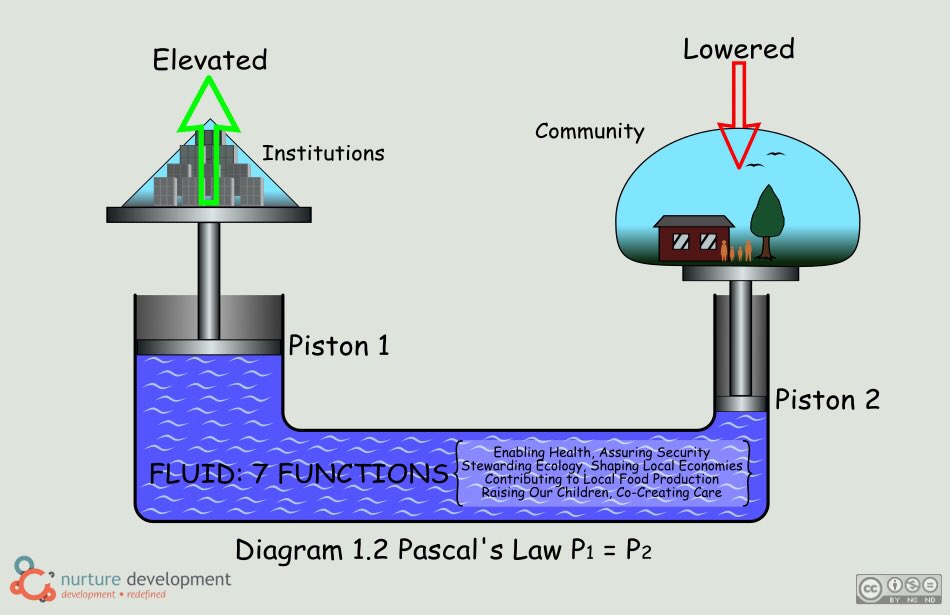
In the last post, Cormac Russell and John McKnight used a hydraulic mechanism as a simple form of a closed system to serve as a simile explaining in a clear, understandable manner the asymmetry of the power dynamic between communities and institutions conjoined in a system of civic governance from an ABCD perspective. This post will look at that same system based on the Kumu Presentation Community Assets versus Institutional Resources using Causal Loop Diagrams which takes more of a Systems Thinking perspective and considers differences between the two.

ABCD and New Community Paradigms (NCP) are in agreement with most of the premises of the hydraulics and community assets system. Both see city leaders claiming to want their residents to see local government as trustworthy and reliable but relegating the role of a citizen to what happens after the city’s professionals’ work is completed.  A perfect example of the hydraulic relationship, an inversion of democracy, the role of professionals goes up, the role of citizens goes down.

Both agree components of community function have been expropriated by institutions or appropriated by the acquiescence of communities so that now people think that more police equals more safety and that more hospitals equal more health. This is illogical from a Systems Thinking perspective as well. Institutional entities define themselves and justify ever increasing budgets by consistently saying they need more funds to deal with all the different problems that the very systems that they propagated helped to create. Their structural role and legacy in the system allow them to sustain that system and the system in turn to sustain them. 

Cormac and John provided three successful examples of taking back collective responsibility for community functions though all were more project-based than systems based and all depended upon viable systems being in place to make them possible.

The manager of a Swedish housing development depended upon a system of support from community builders, connectors at the lunch, as well as welcomers and askers in the neighborhood. Cincinnati Starfire created enterprise space that could feedback to participants' own neighborhoods with resources and money effectively becoming community builders but it was filled with an existing economic and social system. Henry Moore believed that the community had all kinds of functions that could be performed without the city having to do the work. The community took up the challenge and they did the work themselves based on their own existing social system.

There is, however, an example of ABCD being applied on a more systemic basis that is told by Mick Ward, Chief Officer, Transformation and Innovation, Adults and Health, Leeds City Council.  He sets out a history of community development and organizing that gave rise to ABCD in the City of Leeds, England but they started with a strong systemic foundation.

Leeds had been prioritizing tackling loneliness, for older people especially, for many years before adopting ABCD. They had already established Neighbourhood Networks before hearing about ABCD. They then came across Cormac Russell speaking and saw a means to support older people to be even more connected to where they lived.

According to Cormac, the growth of loneliness in modern societies has been increasing since leaving more rural areas for cities leading to the rise of programmatic (and yes, systematic) interventions as loneliness becomes the new pathology being targeted by institutions. More pertinent, can this be reversed by simply changing the direction of the closed system and how does one go about doing that?

This erosion follows the evolution of consumerism shifting to the idea of a consumer society in which one could simply buy what one wants to be produced even that which was formerly the responsibility of the community and put it into the marketplace. We handed over community functions at which we are best competent and capable to perform by employing face-to-face relationship with each other by outsourcing to the institutional realm.

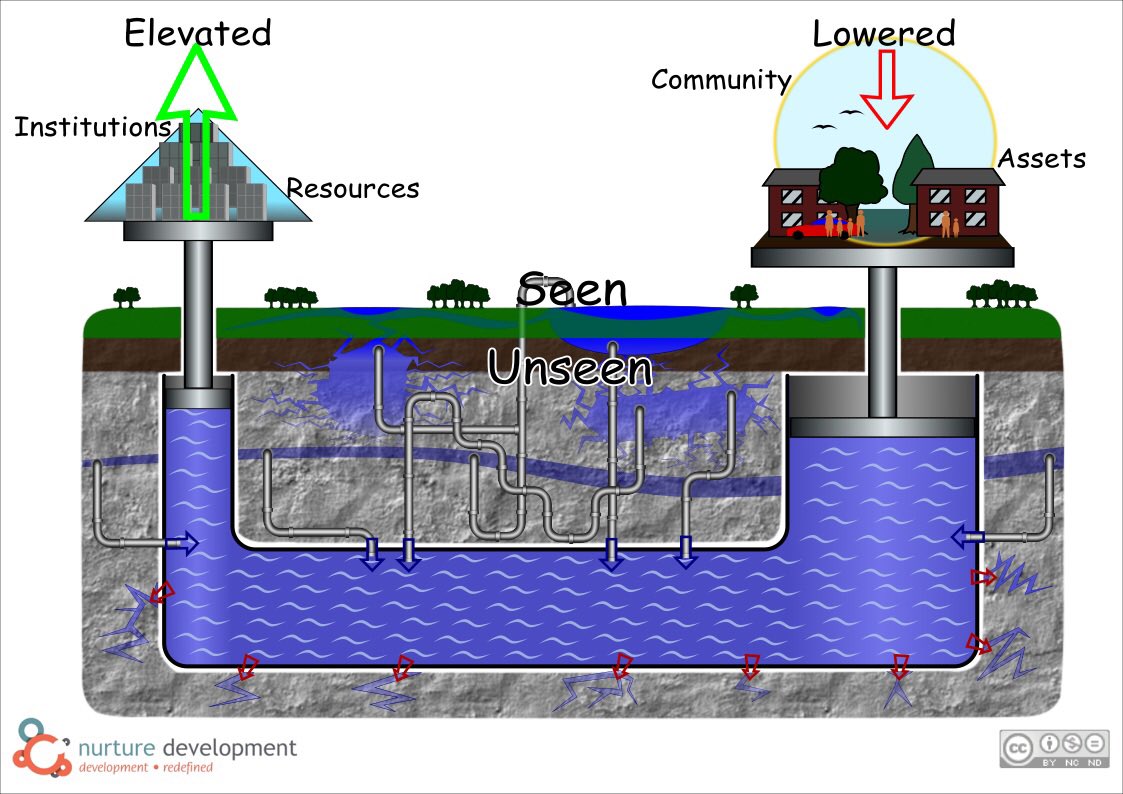
Institutions are closer to being closed systems, similar to a hydraulic system, created as a means of control or applied top-down constraint. Communities, however, are open systems. Their processes are not only nonlinear, but they are also unseen and not understood

Leeds began using a ‘classic’ ABCD framework of establishing a Community Builder in the neighborhood, who identified, enthused, and supported community connectors. Additionally, some “small sparks” funding was provided and community-led asset maps were developed. Early successes demonstrated the approach was worth pursuing in three Neighborhood Networks in Leeds which were part of their previously established ‘Senior Network Support (SeNS) Project’. 

This could have only been possible with a strong community and political support from the leadership of the Leeds City Council and the Health and Wellbeing Board approving funding increase the pathfinder sites, a dedicated post in LCC to commission and support the work, ABCD training both for the pathfinders and those wanting to develop ABCD approaches, supporting ABCD catalysts further supporting emerging ABCD sites to promote ABCD across the city. Still, 12 sites are a long way from covering all of Leeds with over 140 neighborhoods. While this can only be considered a success but can it, using Ward’s term, be successfully proliferated across the entirety of the City of Leeds on this same basis?

Ward wants to expand ABCD as an ‘approach, or ‘way of working’ across Third Sector organizations and services, seeing an opportunity to work with a large range of organizations in the city to move towards a more asset-based approach in their day to day work. This would put ABCD within the civic realm between community and institutions. 

It is not expected though that these organizations, not being ‘pure ABCD’, would be able to use the full ABCD framework as they tend to be city wide-based, rather than neighborhood-based and therefore not as likely to really dive deep and nurture all the potential assets and functions in a community. This suggests then that there is still a need for a more pure ABCD to be established in civil society, perhaps becoming a means of defining civil society, but outside the civic realm, maintaining its independence.  Can ABCD then become a significant part of the civil society’s foundation for the city’s civic realm and how does it do this across all sectors, economic, political, and demographic making up the City of Leeds or anywhere else? 

I have to admit to being skeptical of Cormac and John’s answer as to how this could be addressed by the institutional realm lead by stepping back.  It seems to assume that institutions, those in power within those institutions, and most importantly, the systems establishing and sustaining those institutions will locate some of that appropriated authority back into community life again voluntarily. Perhaps if you are lucky enough to live in Leeds but I have less hope for most places entrenched institutional power.

I have little faith in depending on the accountability and trustworthiness of institutional leaders. Getting even regular folk in our communities to see that people in our institutions, our schools, our police departments, our hospitals, are at their limits, in truth over their limits, and are becoming counterproductive because of all the functions we have given can be arduous. How a community could be resurrected by taking on functions that are the strength of the social contract of neighborhoods in our towns seems a better question but the answer will at least in part be systemic.

The means, Cormac and John say, is stepping forward into our own power, our collective cultural power with the agreement that through social contract there are certain things teachers, police officers, and healthcare professionals are not going to do. Responsibilities that we decide to take back as community. Those social contracts however need to be reestablished under the current systems which are firmly entrenched and will likely need some form of systemic disruption that must be innovative in nature rather than incremental but not lose sight of the purer ABCD vision.

What the Causal Loop Diagrams of the Kumu systems presentation reveals are four possible pathways. 

In the first path, the system maintains its current configuration placing institutional power in a dominant position. Under the current configuration, institutional power has a decided, structural advantage which is made even more resilient through a variety of what Systems Thinking refers to a systems archetypes. Persistent patterns of causality arising from the interaction of causal loops that entrench the system in a manner that is exceedingly constrained but still resilient despite being seen as being detrimental.

Second, both community assets and institutional resources could be reconfigured so that each has a negative influence over the other. 

Third, a more positive configuration initiated as suggested by Cormac and John and made real to a large extent by the City of Leeds. The reverse pushing the other way to increase community assets by outside forces against institutions also requires energy but the system isn't configured to work either effectively or efficiently in this manner. 

Finally, a fourth path based on changes to be initiated by the community itself with or without institutional cooperation. The energy though required to push up or down in either direction does not come from either of the pistons or external sources but must be found in the configuration or structure of the entire system. It is doubtful though, in my view, that either an ABCD approach alone or a systems approach alone could be successful. 

Sunday, May 26, 2019

Hydraulics and Community from an ABCD Perspective

The latest NCP effort wasn't a blog post, it was a Kumu presentation of a systems map based on this infographic.


There have been different versions.


The basic idea though is that if Community Assets are lowered then dependency on Institutions or Institutional Resources is elevated. The infographic was the creation of Cormac Russell, who has been featured in this blog and NCP Asset Based Community Development wiki-page several times. 

Cormac discussed the infographic with John McKnight, who I feel safe in calling one of Cormac's mentors, in the video below, which is part of this Nurture Development Post, The Hydraulics of Community Power. 


Their conversation is a little over half an hour long but the amount of information and insights contained would take far longer to fully unpack. This writing, to which I am not laying any claim, is what I found to be the important points. Hopefully, this synopsis correctly conveys the pertinent facts and authentically retains their expressed perspectives.

The basic idea as presented by Cormac and John is that a hydraulic mechanism in its simplest form is a closed system, pushing down on one part of the mechanism another part has to go up by necessity. Similarly, as a community is performing its functions and institutions are performing their functions, if you push down on one then the other will go up and if you push on the other the reverse happens through processes largely unseen and often not understood. The hydraulic relationship provides an important insight in terms of the power, asymmetry of power dynamics between communities and institutions.

The image is further meant to convey a concept to which should be easily attested, that people know that in most neighborhoods people are not as connected as they would have been 50 years ago and raises the question, why and what are the ramifications?

Cormac and John provide examples of components of community life, education, public safety, and health that have been expropriated by institutions or appropriated by them through the acquiescence of communities, invariably implicit as nobody votes for it. Bringing people to think that more police equals more safety or that more hospitals equal more health.

The state of the educational systems in the US can be explained to a great extent by the multiple community functions taken over by schools. Eighty-five functions since 1900 according to the book, ”Schools Can't Do it Alone.” The educational institutions have been expropriating community functions that have fallen mainly on the shoulders of teachers, a clearly crushing responsibility at which they are doomed to fail.

Police Departments are struggling with the problem of not having the members of the community involved, as though they had nothing to do with the issue of security and safety. More enlightened Police Departments have come to understand that the connection isn't simply about getting the community to call the police and report on their neighbors. There is a very clear community function around the production of safety. It is an association or function of community life itself. Neighborhood policing has become much more about community building and less about enforcement and informing.

At the same time, Police Departments and other institutional entities are still defining themselves and justifying ever increasing budgets by consistently saying we need more money to deal with all these different problems.

Medical practitioners cite similar relationships in health to those around education and safety with eighty-five percent or even higher of what determines well-being having nothing at all to do with clinical or pharmacological intervention or anything that a medical professional can do to us. Most of what counts for the healing of suffering happens outside the medical institutional realm. One primary care doctor, a public health practitioner who runs a primary care facility said that forty-five percent of the people who come into his surgery is not biomedically ill. They're lonely, disconnected in some way. A word for their condition is isolated, they are in a sense alone. Perhaps they have some moderate challenges in socializing but technically they're not sick. They need commune they don't need a doctor.

The growth of loneliness in modern societies has been increasing even though we see ourselves in cities as all collective. Our loneliness, according to Cormac has been growing as we left the more rural areas. In Vancouver, Canada a foundation gave a list of about 40 issues and asked residents to rate them and the number one issue was not crime or education but loneliness. What we're seeing now is the rise of programmatic interventions around loneliness. Loneliness has now become the new pathology that is being targeted with programs by institutions.

This erosion has come through the evolution of consumerism. It is a shift to an idea of a consumer society in which one could buy what one wants to be produced, being individuals who took that responsibility out of our community and put it into the marketplace. It's the consumer economy built on the assumption that we can outsource these at one-time community functions to the institutional realm so that we can get on with being consumers.

Marketing and media, over and over again, are trying to persuade us that it is better to buy a life than it is to live one. Advertising things that will be done for money that we would never have seen in the past done for money.

We now turn to institutions to buy through taxes and charitable donations solutions for the issues we face collectively but that shift in culture is problematic because so many of those functions are ones that only people in face-to-face relationships with each other can really perform effectively.

We have been handing over functions at which we are most competent and most capable to perform. The institutions are appropriating all of these new functions, yet they are overburdened and are less able to do their actual legitimate functions becoming a collective equivalence, as Cormac noted, of the Peter Principle where institutions are elevated to their own level of incompetence.

City leaders, responsible for dealing with these issues want their residents to see local government as trustworthy and know that it can be relied on but all too often in their minds the role of the citizen is defined as that which happens after the important work of the professionals is completed. This is a perfect example of a hydraulic relationship. The role of the professionals goes up, the role of the citizens goes down. This is an inversion of democracy for it needs to be the case that the role of the professional is what happens after the important work of the citizen is complete.

Cormac and John then asked how does the institutional realm lead by stepping back? How do we locate some of that appropriated authority back into community life again? How can we resurrect the community in taking on the functions that are the strength of the social contract of neighborhoods in our towns?

John thought of it as being almost forceful in nature on many institutional leaders because of their accountability and defining trustworthiness. That what they could do is get folks, people in our communities, to see that our institutional people, in our schools, at our police departments or hospitals, are at their limits, in truth over their limits, and are becoming counterproductive because of all the functions we have given them.

The alternative is stepping forward into our own power, our collective cultural power with the agreement that through social contract there are certain things teachers, police officers, and healthcare professionals are not going to do. Responsibilities that we decide to take back as community.

Cormac and John also provide three successful examples of taking back responsibility for collective functions of, by, and for the community.

The manager of a large housing development in Sweden sent out an invitation saying if are you lonely come next Tuesday to the dining room and we'll have lunch together had eighty-some people show up. The manager was able to succeed because he had support from community builders in the neighborhood in addition to connectors who were also at that lunch, as well as welcomers and askers in the neighborhood.

Another example Cincinnati Starfire, a workshop placement for people with intellectual disabilities that reimagined its role through its participants and became an enterprise space where local small businesses pay rent and establish small pop-up offices in which they operate. More importantly, participants are also out in their own neighborhoods with resources and money that they can spend effectively becoming community builders who are contributing to their neighborhoods. The professional staff is also out in the neighborhoods with them, supporting them, supporting relationship building so they too are core community builders.

Then there was Henry Moore, the assistant city manager of Savannah Georgia who sent a letter to the people in the lowest income neighborhood asking them to write a letter no more than one page saying what they would like to do to improve their block and have two other people sign it who will also do it with a maximum grant of $100. The first year he got eighty requests with very little money spent. From an institutional point of view, it was one of the most incredible ways of beginning the change of the hydraulics system. He was saying to the community, you have all kinds of functions that you can perform. How do we support you? He also said We (the City) are not going to do work, the community took up the challenge and they did they work. In the past, investment had been put in from the top through Community Block Grants. ”When I had the block grants that made almost no change but when I led by stepping back and provided the incentive for citizens to be producer things changed”.

Below is the Kumu presentation looking at the same subject from a Systems Thinking perspective.
The next post will examine some of the differences.


Saturday, May 4, 2019

ABCD as a Systemic Means and Support to Ostrom’s Commons

The previous series of three posts attempted to bridge Asset Based Community Development (ABCD) with Systems Thinking, the two sections of the New Community Paradigms (NCP) wiki seen as being among the furthermost separated. Bridging NCP wiki-sections is a basic feature of the wiki, especially with the NCP wiki-map but the differences in conceptual approaches between the two are especially distant. Both were discovered in this search for new community paradigms. There is a bias towards Systems Thinking, not due to longer exposure, 2015, 2016 in earnest for ABCD and 2013 for Systems Thinking but to a natural affinity. Still learning both. The bridging of the two was done across a presumption of complexity incorporating both. Complexity, to be clear from the start, is seen as actually a good thing and necessary though all too often incoherent if not problematic.

The recent blog post, Ostrom, the Commons, and the Green New Deal continued to explore the development of concepts involving dynamic complex systems previously raised in this blog. In addition to bridging concepts, there is a desire to establish a deeper and firmer foundation through biological constructs such as Carrying Capacity and an interest shown in Ostrom's work by anthropologists.

This post questions how far ABCD relational practices and Ostrom’s polycentric governance can be extended limited by the increasing complexity inherent in larger groups or wider circles of Dunbar's Number. The reach of ABCD, and more indirectly Ostrom's polycentric governance, is arguably restricted by Dunbar's Number.

There are four layers, or "Circles of Acquaintanceship," or implicit social contracts making up Dunbar’s number scaling relatively consistently to each other. The first circle is three to five of our very closest friends. The next layer or circle is twelve (the size of a jury) to fifteen persons whose death would devastate us. Next circle is made up of fifty persons, or “the typical overnight camp size among traditional hunter-gatherers like the Australian Aboriginals or the San Bushmen of southern Africa.”

Beyond the fourth level of one hundred and fifty persons, there are still further circles with an ideal democracy set at five thousand, three hundred. Larger circles though involve even greater degrees of complexity and far less emotional attachment, especially between non-familial relationships.

Though usually in agreement or sympathy, there are a few points with which I don't see the same as Cormac Russell, Managing Director of Nurture Development and faculty member of the ABCD Institute, leaning towards Dunbar’s empiricism but then I am a keeps-himself-to-himself in-his-own-head type introvert so biased in my perspective.

Cormac does not include family members (or professionals), only true associates, in his associational connections and Dunbar does with kin prioritized. He sees Dunbar’s fourth level at 150 persons as a minimum meaning most of us have a deficit of 99 persons, not including familial relationships, to make up for from our average base of 51 persons in our associational lives. He knows that Dunbar saw the fourth level of 150 as a maximum limit which I suspect few people truly reach. It is not just walking distance separating people but emotional distance as well. As the number of people in a circle increases the emotional connection between them decreases with each successive circle and there are physiologically set cognitive limits.

However, it is Cormac’s vision of community associational relationships that must be strived towards to create the needed systemic changes in the direct democracy governance of our communities which requires not only connections but diversity as well to deal with complex even wicked problems. ABCD then becomes a necessary and even a primary component of New Community Paradigms but not necessarily a sufficient one.

The question to be considered then is how Ostrom’s polycentric governance of community and the commons could help ABCD extend the network of implicit contracts and, as importantly, how ABCD could support Ostrom’s polycentric governance to develop the required trust essential to achieve the advantage of those implicit social contracts.

As has been asserted before, Asset Based Community Development seeks to help communities find solutions to community challenges upon the basis of a system of community-based associational relationships to develop community wealth or resources as opposed to economic wealth or money by a few.

Most larger geographically placed, politically defined by institutional government type communities such as cities or towns are usually composed of many diverse socially and often demographically defined place-based communities or neighborhoods of differing levels of influence.

There are other distinct types of community in addition to these that can extend beyond geographic boundaries but still not be necessarily separate. Communities, in the context of this post and ABCD, will refer to neighborhoods and smaller social-based communities. Larger entities such as cities are dealt with through their institutions.

The previous series went over questions that ABCD believes each community or anyone sincerely wishing to build better communities needs to ask. An issue for many communities then is whether they or anybody are even asking these essential questions? ABCD seeks to change this by committing to re-seeding associational life at a hyper-local level (i.e. street level). ABCD is about the strengthening of social capital or what could also be considered the Carrying Capacity within a community to save people from a life of institutionalization by creating community alternatives to the institutional (systems) world.

ABCD and Community, a Systemic Analysis pt 3 reminded us that the carrying capacity of a local community depends upon good stewardship of that community’s welfare ideally requiring the correct sequencing of nurturing at three levels. The first level is recognizing that there are things that communities do best on their own without institutional assistance. The second level is recognizing that there are things that communities can basically do themselves but with some help from outside agencies. The third level is recognizing that there are things that communities need to have done for them by outside agencies. Something institutions readily and often exclusively do.

At the third level, the system being generated likely becomes entrenched, leading to a form of top-down service delivery by command, being persistent and resilient even while failing to address the needs of its supposed beneficiaries while eroding social capital and creating high levels of dependence on external resources which are now disappearing.

Neighborhoods have experienced years of interacting with the different public and private institutional agencies which have provided services of one kind or another, under the auspices of governmentally defined agencies, but not at equal levels. Outside agencies, institutional or otherwise, ideally should seek to be in the right relationship with smaller social, demographic, cultural communities. However, it has been many of these very same agencies who have failed, are still failing, and are now looking for means to systematize their failure as a new normal.

Cormac sees this institutionalization causing further atomization or breaking up of relationships or people’s sense of community into individual elements in what I believe can be interpreted as being a system of disorganized complexity. This is not considered an oxymoron, even disorganized gas molecules can be made to react (behave) in certain ways through proper manipulation. ABCD though could also involve the atomization of a community but to the level of independent agents connecting potentially in a self-organizing fashion through a system of organized complexity as defined by Jane Jacobs, structured by Ostrom and systematized by Meadows.

Without proper investment in community building through the correct Agency interactions or better community conversations, institutional stewardship remains stuck at the third level while second level interactions can be commodified drifting towards the third level in the name of efficiencies and there is little incentive to make any extended investment. The first level carrying capacity then is relegated to fighting to retain whatever influence on to which the community may be holding on let alone endeavoring to increase its social capital.

What leverage then is afforded to local communities or even those working sincerely and earnestly in support of local communities to ensure that this is done properly? Even if attempted, providing the proportionate support that does not displace or diminish local community power is a difficult balancing act with the best of intentions. It isn't by the communities themselves, at least not initially, and it is doubtful that it is the institutional agencies so is there presumably a third sector or movement outside of these communities that are being appealed to beyond the already converted to the ABCD approach?

This post will also reveal the connection of ABCD back to the concept of the Commons and Ostrom’s work, a path already established in the blog post-ABCD, Social Networks and the Commons connecting Associational Life:

“A viable way to be collective and inclusive from the bottom up, according to Cormac and those with a similar mindset, is to work through the concept of the communal Commons to enable some type of Coalition of the Doing in determining the relationship between Capitalism and the Commons".

David Bollier, Director of the Reinventing the Commons Program at the Schumacher Center for a New Economics, starts off the article speaking of enclosures as the historical anthesis to the Commons.

“Enclosures eclipse the history and memory of the commons, rendering them invisible. The impersonal, individualistic, transaction-based ethic of the market economy becomes the new normal.”
An enclosure, as defined by Bollier, then can be seen as a form of imposed exclusion, a means of differentiating between clique or exclusive communities and colony or excluded communities.

A Commons, within an ABCD framework, can then be seen as both place-based with the resources of that place and people-based as an associational network overseeing those resource-based commons. The Social Network is both a people-based defined social system overseeing the Commons as a place-based resource so that the smallest associational successes of ABCD can not only reverberate through the entire community (system) but also give it history or legacy. It becomes a matter then, as Cormac has said, of not reforming (institutional) systems but reclaiming the Commons.


Sunday, April 21, 2019

ABCD and Community, a Systemic Analysis pt 3

This post will continue with the development of concepts presented in the previous two posts of this series.I raised my own limitations regarding Systems Thinking and especially Asset Based Community Development (ABCD) in the first post. This post has an additional limitation for this series regarding the scope of this analysis. It only deals with ABCD from a limited perspective. ABCD is far richer than what is being presented here, similar to using the Logistic Equation to explain changes in population, hopefully, useful but only a sketch.

Asset Based Community Development or ABCD seeks to define an ideal relationship between institutions, including the agencies through which policies are implemented in pursuit of their mission, and communities, particularly what has been termed colony communities or marginalized or dependent or so-called hard-to-reach (HTR) communities.

As Cormac Russell has said, the carrying capacity of a local community depends upon good stewardship of that community’s welfare ideally requiring the correct sequencing of nurturing at three levels to discover the community’s underpinning capacities and in a way that does not function to harm the social capital of the community. The result of such good stewardship in times of crisis should be sufficiency and the potential for greater abundance, not scarcity and abandonment. These three relationship levels, however, presume a benign power relationship or better between community and institution.

The first level is recognizing that there are things that communities do best on their own without institutional assistance. This requires asking though, what are the things that only residents/citizens can do in response to an issue? These should be determined regarding the strengths of the community, not its deficits.

These are the things for which a community already has the adequate inherent carrying capacity to do best on their own though this may not yet be realized. The efforts are purposefully applied by the community and should not be supplemented by purposive institutional programs. Any involved agency is hopefully facilitating these efforts to help make the efforts more efficient and helping to remove barriers not creating them. This though cannot be assumed.

The second level is recognizing that there are things that communities can basically do themselves but with some help from outside agencies. This level is beyond the carrying capacity of what a community can do solely on their own but could perhaps do with some help from an outside agency.

The carrying capacity of the community is not fully adequate to the task either because the extra needed capacity to some extent remains external or is inherent but has not been fully realized. What then are the things that residents/citizens can lead on and achieve with the support of institutions and their agencies (governmental, non-governmental, for-profit) in response to that issue? As important, can those agencies be expected to provide support to the community in doing what it can’t do for itself?

If so, those outside agencies should then ideally facilitate such activities so that the carrying capacity of the community goes as far but no further than is sustainable. Outside agencies should seek to be in the right relationship with communities and provide proportionate support that does not displace or diminish community power.

The third level is recognizing that there are things that communities need to have done for them by outside agencies. The required carrying capacity is both external and unrealizable by the community. The questions for the community then are not only what are the things that only institutions can do for us (residents/citizens) but as important, what can the community do to induce the agency to do for the community what the community can’t do for itself.

The agencies should then seek to do those things in as transparent and accountable a manner as possible but the scaling required to address the issue may be imposed on the community rather than induced by the agency.

The Nurture Development post, What We’ve Tried (in isolation) Hasn’t Worked: The Politics of Community, raised questions that need to be answered by or for a community so that the locus of control over a community’s carrying capacity is by the community, not an outside institution. The factors defining the three levels of relationships between communities and institutions can be expanded to enlarge the overall community based social carrying capacity.

The community needs to develop the extended carrying capacity or social capital to be able to determine:

  • What are the things that institutions can stop doing which would create space for resident action, enlarging the community social carrying capacity?
  • How agencies can create space for the community to grow in that capacity, moving from dependence to self-sufficiency and independence.
  • How the agency can determine, what the agency can do to go beyond its current level of community support?
  • What can institutions start offering beyond the services that they currently offer to support resident/citizen action?
The institution examines its mission or purposive functions or better the community purposely examines and redefines the mission of the institution to provide unrealizable and external but needed or desired carrying capacity and enhances the previous three levels of relationships.

The community often either does not have the carrying capacity or social capital on its own without help which is either never offered or if given can be threatened so that the institution and those who benefit maintain control. This means purposefully enhancing the inherent but yet still unrealized carrying capacity of the community to add to its needed social capital. It is difficult seeing this done through the purposive actions of an institution. A call for an institution to unilaterally remove barriers that it put in place would seem to argue against that community having sufficient carrying capacity on is own to scale to the next level.

The institutions are expected be to either move the community to a greater sense of inherent and realizable carrying capacity or to accept responsibility for external and unrealizable but still desired carrying capacity as part of its mission.

This requires a purposeful systemic change for which whether at first internally realized or unrealized is likely initiated through external carrying capacity if only as a catalyst. A required a change in the power relationship between the community and institution, an enhancement in social capital or the type of carrying capacity utilized by the community from direct and independent with the community directly doing things on its own to more indirect but controlled, things are done through an agency but the community holds greater control.

Cormac has pointed out that the power relationships of communities with outside institutional agencies have changed over time with institutions claiming that service delivery is neither sustainable nor ironically empowering. Austerity, defined by these institutions and implemented by agencies, means the communities now have fewer outside resources available so have more of the responsibility for maintaining carrying capacity, including taking over care of those who are highly service dependent, which is again a form of harvesting of that community's carrying capacity.

A question then is who specifically is the "We" whom Cormac speaks of that needs to learn from communities what they can do and care enough about to do with or without outside help. Who is the “We” that not only helps communities determine what they can do with some support, and only then helps in determining what external resources are needed but also helps in negotiating with the government institutions or enhancing the carrying capacity of the community to do such on their own?

Now I know that the answer is us, being both the enemy we have met as well as being the ones that we have been waiting for. The devil though is in the details. Direct democracy, in some form, combining both participatory democracy, emphasizing ABCD and deliberative democracy, emphasizing Systems Thinking is one potential path to needed new community paradigms.


part 1
part 2

ABCD and Scaling Carrying Capacity pt 2

This post will continue with the development of concepts presented in the previous post of this series which included the reintroduction of carrying capacity. Any change in the level of community social carrying capacity involves scaling in some form. However, ABCD tends to prefer terms such as ”proliferate” being very wary of ‘industrializing’ or ‘going at scale’ by institutions.

Scaling can generally be defined, using Wikipedia, as changes to a system such as a community in terms of some capacity in one of two ways. One is uniform or isotropic scaling in a linear transformation. If a fishing community doubles in population then it needs to catch double the amount of fish or find substitutes.

Scaling can also be defined as a power law, as a functional relationship between two quantities, where a relative change in one quantity results in a proportional relative change in the other quantity, independent of the initial size of those quantities: one quantity varies as a power of another. If that same fishing community builds better boats going out further at sea catching bigger fish, the carrying capacity increases superlinearly allowing for increased population or greater creation and consumption of resources per capita (ignoring the overall capacity of the resource).

Natural carrying capacity is always inherent, realized and purposive which through extraneous and environmental changes can alter and even lead to the collapse of a population.

Community social carrying capacity and its extension community social capital can be either inherent or external, realized or unrealized, and either purposeful or purposive. The scaling of social carrying capacity can be categorized in three ways - imposed, induced, or inherent.

A Nurture Development post asking, “Scale is Important but Who’s Scale Are We Talking About?” is more of a warning than a question. It advises against attempts to scale or grow beyond a community's own carrying capacity, usually for the benefit of outside agencies.

Imposed scaling would be what Nurture Development warned against but could be seen, at least in my view, not as scaling but a form of colonial harvesting or appropriation of the resources of a community by an institution. Communities are asked to scale their efforts to extend them beyond the community's geographical boundaries or spheres of influence. As a result, a community's own carrying capacity and its established known and predictable processes (the way it works) are likely to be diminished and won't work the same way elsewhere.

Induced scaling, or more bang for the buck, is what agencies such as Acumen endeavor to achieve with their programs such as providing malaria nets at a lower cost per net to provide even more nets. With induced scaling, the burden is not placed on the community being assisted until it develops the capacity to carry it themselves.

Inherent scaling refers to the natural scaling of complex systems whether biological, as in animal populations or sociological such as cities. Professor Geoffrey West has demonstrated that cities naturally scale at a rate of about 15% in savings in terms of economies at a sub-linear rate for infrastructure, having an analog to biology, but scaling at a superlinear fashion at 15% growth with socio-economic network factors.

Inherent scaling in the larger social environment is likely to put pressure on the need for increasing carrying capacity by communities. Inherent scaling though does not naturally result in the equitable distribution either of benefits or of detriments created by the system in the form of socio-economic entropy. A larger issue is that the entire system or collection of systems is likely destined to collapse from the stress being generated without major interventions or transformation of some type. These concepts are expanded upon here. In actuality, all three of the forms of scaling are likely to be ongoing at the same time.

An ABCD definition of community incorporates inclusion. Communities can be categorized whether they define themselves by inclusion or exclusion and by whether they are dependent upon institutions or instead they are either independent or have control over those institutions.

Inclusion could be seen as part of the community’s receptivity influencing the level of its carry capacity and social capital and significantly changing without it the nature of the community.

M. Scott Peck’s definition of an inclusive community is complex, open, and organic. Communities are living organisms.

“Community is and must be inclusive. The great enemy of community is exclusivity. Groups that exclude others because they are poor or doubters or divorced or sinners or of some different race or nationality are not communities; they are cliques – actually defensive bastions against community.” 


Matthew Petrusek’s definition of inclusion and its supposed logical incompatibility within a community is complicated and restrictive. Communities are things.

”But we have every reason to advocate for coherence, as well. Many characteristics of a community certainly are negotiable and can be flexible, even to the point of breaking, in the name of inclusion. But some things, or at least something, must be non-negotiable.” He arguably could still have a point though in a community being allowed to maintain its identity at some level. Too often though this is used as a means of exclusion.

Communities with the power to define themselves by exclusion and still be economically self-sufficient both individually and collectively can be considered cliques. There are then those things that clique communities, through sufficient social capital, can have done for them by outside agencies either because of need and an inability to do so individually but also because of convenience, they want it and it is more efficient for the institution to do it for them and they can effectively negotiate the means of delivery.

Communities without the power to define themselves and that are dependent on agencies can be considered colonies and subject to harvesting by being restricted in the development of their own capacity, by the diversion of resources or by direct appropriation. Colonial communities are also defined by exclusion by the in-use purposive policies of institutions regardless of any espoused claims. Abundant communities, as the ideal alternative, are both self-sufficient and inclusive.

Colony communities do not have the extended social capital to address directly those issues it can through community carrying capacity and using social capital to successfully influence outside agencies to do for it what it can't on its own or to transition from one to the other.

The means of moving past being a colony community or being designated an HTR community (hard to reach community) starts with greater inclusion by both dependent and more self-sufficient communities. Part of the carrying capacity then has arguably come from outside the community but agencies, working sometimes on behalf of those responsible government institutions, maybe competing for resources that are instead being distributed to competing communities.

It becomes then a question of both motivations and of capacity for both the community, or more likely communities, and their associated institutions. Particularly if multiple communities are competing for institutional influence on a political basis and the relationship between a particular community and the controlling institutions may be a confrontational one.

There can be continued maintenance and even manipulation of institutional systems for the benefit of some at the cost of others. People can be redefined or commodified as service users or patients and thereby be defined out of community resulting in the consequent depletion of carrying capacity of that community that was supposedly being helped.

Outside agencies also have different pressures from budgetary committees requiring the imposition of scaling on their assigned efforts that achieve cost savings for the institution. These pressures not only can’t be discounted by agencies, but they also need to be optimized, under the best circumstances, to provide the best possible service with limited resources to the greatest number.

There is then an even greater need for increased social capital through social networking by bonding and bridging tied together in a manner that is both collective and inclusive but which ABCD would insist should be more people based than technology based.

This raises the question though whether ABCD simply focuses through relational consensus on the maximum carrying capacity of each community with special attention towards challenged ones or actually addresses issues between different competing communities through democratic principles?

The role of ABCD in working with communities is separate from the provision of institutional services through agencies and is not meant to save institutional systems money. It is to build community (verb) for the community (noun) to decide its own purpose. There seem to have been some successes in community and agency partnerships fostered by ABCD, particularly with healthcare but while empirically verifiable as to what works, establishing theoretically as to how they work remains less clear to me. The final post of this series will look at this more closely.


part 1
part 3

ABCD, Carrying Capacity and Communities pt 1

The last post dealing with Elinor Ostrom and the Commons cited previous inquiries into complexity, carrying capacity and Asset Based Community Development (ABCD) with an intention to return for further inquiries.

It was Cormac Russell’s post on Nurturing the Carrying Capacity of Communities that was the inspiration and a primary source for bridging ABCD with dynamic complexity on a premise that communities of all types are dynamic complex adaptive systems. Carrying capacity defined as the number of members of a population or in this case a community that can be supported based on resources and environment before it begins to degrade its equilibrium population or the system's receptivity and resilience. This post will add in System Thinking into the mix helping to serve as a connector from complexity and carrying capacity to ABCD.

Some of the concepts discussed back then are going to be amended or expanded in light of new information or insights. The term carrying capacity when applied to community should be expanded beyond simple numbers to include the attributes of that community and extended relationships that defines its existence. People don’t necessarily die, they can leave or have diminished lives but the community may cease to exist.

The first step, because some may consider the terms nearly synonymous, will be to first operationally define “institutionalization” seen negatively by ABCD, and by extension define “institutions” for which Nurture Development’s take will be used. Then define “systems” which will come from what has been learned through this NCP effort. Upfront there is agreement with Nurture Development’s take on institutions.

Institutionalization is logically brought about through institutions but while most definitions of institution are seemingly benignly ideal, “institutionalization” less so according to Nature Development articles like, Beyond Good Intentions; Towards A Good Life which raises real fears that include, “If I make people dependent on a system that cannot provide ongoing love and mutuality without the hidden cost of unintended institutionalization and loss of autonomy”. In Why Place Such A Strong And Focused Emphasis On Place-Based Community Building?, institutionalization is seen as a bad thing bringing forth a call for a “radical form of inclusion that seeks to grow interdependence in community life and reduce institutionalization among those who have become most marginalized”. The Nurture Development article Organizing Institutions To Support Family And Community Care further explains, “Recent responses to institutionalization around the world, especially in Europe, Oceania and North America have involved asking staff who work in human services institutions to alter their caring approaches to become more person-centred and less prescriptive.” Then adds, “But there’s the rub with person-centred care, it can’t simply be achieved by staff changing practice (though that will help), because the issue is largely the context. Therefore, change in human service institutions must also involve decommissioning services that have become too big; impersonal and congregated, and shifting the orientation back towards family and community.”

So what is meant by something being a system? One operational definition used by systems thinking is "A system is an entity that maintains its existence through the mutual interaction of its parts.", Ludwig Von Bertalanffy. I lean toward, Donella Meadows, featured in the last blog post and one of the authors of Limits to Growth, who has a similar definition, “A system is an interconnected set of elements that is coherently organized in a way that achieves something…. a system must consist of three kinds of things: elements, interconnections and a function or purpose.”

Institutions, governments, communities, families and even ABCD are all systems, and although far from being identical in nature, all incorporate feedback.

Systems may be thought of as something that processes things systematically, without feeling, in a mechanical manner. The most salient point about systems I would argue though is that systems operate systemically and it is from that which systematic processes and outcomes arise of multiple and sometime complex varieties. For others, the term systems is colored by constant battle against “The System” which is but one instance of a system, undoubtedly egregiously entrenched but subject to all the principles of every other system.

The most crucial determinant of a system’s behavior is purpose or function despite often being the least obvious part of a system. A change in function or purpose can be drastic, changing a system profoundly, even if every element and interconnection in the system remains the same. For myself, this means that if two systems have the exact same elements but a different set of interconnections between those elements and different purposes then they can be considered two distinct systems.

I see a difference between purpose and function, though the terms are often used interchangeably. There are, in my interpretation, two different types of purpose, “intentional” and “inherent” or what has been referred to as “purposeful” and “purposive” respectively. Peter Checkland, said that purposeful behavior is that which is willed, involving voluntary action particularly applicable to human activity systems. This is what I would label intentional purpose. Purposive, according to Checkland, is addressed through "What would I learn from attributing (externally) purpose to this situation?" An engineered or even a natural system can exhibit behavior to which purpose can be attributed. This is what I am referring to as inherent purpose or what Donella Meadows seems to have termed as function.

Both Meadows and, especially Stafford Beer advise us that the Purpose Of A System Is What It Does, not what we want (this is an arguable point, I have had the arguments).

As to my own thinking, ”The goal or better function (the purpose then is the goal) of a river is to flow into a lake or ocean. The river does not do this intentionally on purpose. Rather it is a step or function in a feedback loop of the world’s hydrology system and subsequently an element in many other systems, including ecological, fishing and shipping”.

I don’t consider myself an expert on Systems Thinking and have even less insight or knowledge about Asset Based Community Development but will still explicitly state some premises concerning ABCD. ABCD is based on the simple logic that communities can’t know what external supports they need (from institutions, agencies and other organizations) until they first know what are their internal capacities or extending to a perhaps more speculative proposition what is their carrying capacity and their social capital, or the “social networks, bonding similar people and bridging between diverse people, with norms of reciprocity”, seen as an extension of carrying capacity? This will involve relationships of communities with outside institutions and agencies whether governmental or private.

An NCP principle that should be raised is recognizing that there is a difference between government and governance, the former being the realm of institutions and the later the provenance of community. It is their disconnection that becomes detrimental to community welfare.

With this series institutions and agencies will be differentiated. Institutions use different agencies to implement policies. State and church are different types of institutions but each can have agencies working to alleviate poverty. Institutions and agencies or organizations, and the agents working within them can, even when connected, have differences in motivation and interactions with the community. Communities are purposeful though often at cross purposes. Institutions are purposive. Agents with agencies often strive to work purposefully but are constrained by efficiently functional or purposive institutions.

Institutions don’t have carrying capacity they have missions, goals and objectives. Communities invest their social capital into institutions delegating control and responsibility. As systems, institutions are invariably complicated in structure, sometimes exhibiting a level of extreme ”complicatedness” though inevitably complex in their interactions with communities. This resulting complexity though all to often restricts the adaptive complexity of communities.

Institutions have a function, to fulfill a purpose but that purpose although it may have been initially been determined by a community or components of that community as a system, a living, complex adaptive system that initial purpose can be lost.

Community, institutions and agencies are meant to be one system. These factors need to be maintained in alignment for the desired ideal outcomes to occur but this too often fails to happen. Instead, corrupting patterns of interaction lead the system, that defines the institution, to be calcified into entrenched patterns propagating the system into self-serving structures and producing mental models professing that things cannot be changed perpetrating its existence. A question that can be asked then is to what extent did the institution corrupt itself and to what extent was it the result of neglect on our part? What we seek is not institutions entrenched in the daily lives of our communities but agencies embedded through trust that, as Cormac Russell has said, are embedded properly by local residents who say this is a way we can live together and prevail here.


part 2
part 3

Past Posts